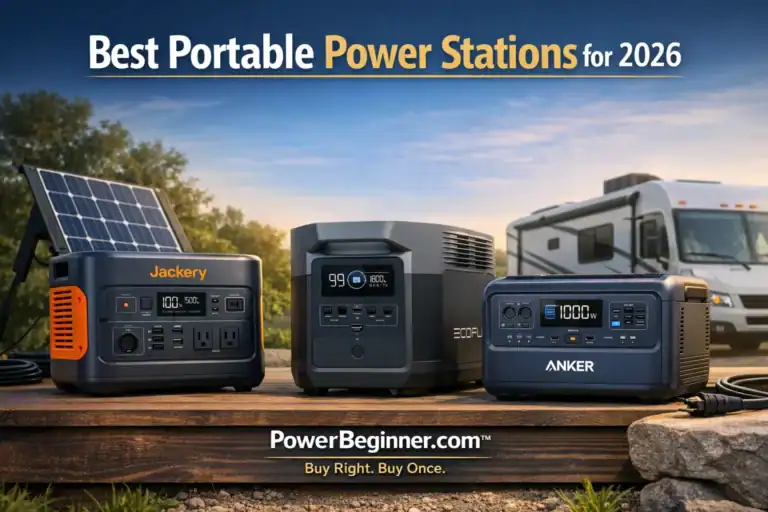
Portable power stations offer silent, emission-free backup power you can use indoors. Here are the models actually worth buying in a crowded market.
Gas generators work. But they’re loud, smelly, and you cant use them inside without risking carbon monoxide poisoning. For apartment dwellers, RV owners, and anyone who wants backup power without the hassle of gas engines, portable power stations offer a compelling alternative.
These battery-based units store electricity and dispense it through standard outlets, USB ports, and 12V connections. Charge them from the wall, your car, or solar panels. Use them anywhere. No exhaust, no noise, no fuel to store.
The technology has matured significantly in recent years. Early portable power stations were expensive novelties with limited capacity. Current models offer serious power at reasonable prices, with lithium iron phosphate (LiFePO4) batteries that last thousands of charge cycles.
Understanding Power Station Specifications
Before we get into specific models, you need to understand what the numbers actually mean.
Watt-hours (Wh) measures stored energy—the total fuel in the tank. A 1,000 Wh station can theoretically power a 100-watt device for 10 hours, or a 1,000-watt device for 1 hour. Real-world performance is slightly lower due to conversion losses.
Watts (W) measures power output—how much the station can deliver at once. A 1,000 Wh station with 1,500W output can power a 1,500-watt device, but only for about 40 minutes before the battery empties.
Inverter efficiency affects usable capacity. Most stations lose 10-15% of stored energy through the DC-to-AC conversion process. A 1,000 Wh station typically delivers 850-900 Wh of usable AC power.
Battery chemistry matters for longevity. LiFePO4 batteries last 3,000+ charge cycles and are safer than older lithium-ion chemistry. Older Li-ion batteries might last 500-800 cycles. The price difference is worth it for equipment you’ll own for years.
Best Portable Power Stations
Best Overall: Jackery Explorer 1000 v2
No products found.
Jackery essentially created the consumer portable power station category, and the Explorer 1000 v2 represents their current flagship for most buyers. At 1,070 Wh capacity and 1,500W output (2,200W surge), it handles most household backup needs.
The LiFePO4 battery chemistry provides over 3,000 charge cycles—roughly 10 years of daily use before significant capacity degradation. That longevity justifies the investment in ways older lithium-ion stations couldn’t match.
Fast charging gets you from 0-80% in about 1.8 hours via wall outlet. Solar input supports up to 200W, enabling full recharge in 5-6 hours of good sunlight with appropriate panels. The app provides remote monitoring and control.
Over 4,400 reviews averaging 4.7 stars. This is the power station people recommend after owning it through multiple power outages and camping trips.
Best Value: EcoFlow DELTA 2

- Clean, Green Charging. With up to 500W of solar panel input, DELTA 2 is a solar generator that can be charged while camping, on an RV trip or off-grid. Includes a 220W Bifacial solar panel to capture up to 25% more energy.
- Built to Last 6x Longer. Its LFP battery chemistry makes for a portable power station with a 3000+ cycle life. Enough for years on end of use. With a sophisticated BMS, you can go easy knowing its an auto-regulating portable battery to keep you safe.
- Power Almost Anything. Solar powered generator have come a long way. Power all your appliances with 1800W output, that's on par with outdoor generators without the fumes or noise. With 15 outlets and its huge output, you can power 90% of your appliances.
- Expandable Capacity from 1-3kWh. With the standalone portable power station sporting 1kWh, you can add on extra batteries to reach up to 3kWh. Ideal for camping, RVs or home backup power.
- What you Get. DELTA 2 Power station, 220W Solar panel, Adjustable kickstand case, AC charging cable, Solar charging cable, User manual, and an exclusive 5 customer service.
EcoFlow has emerged as Jackery’s primary competitor, often with more aggressive pricing and comparable specifications. The DELTA 2 offers 1,024 Wh capacity and 1,800W output at prices that frequently undercut the Jackery equivalent.
The standout feature is charging speed. X-Stream technology refills the battery from 0-80% in just 50 minutes via wall outlet. When you need power quickly before an approaching storm, that charging speed matters enormously.
LiFePO4 battery chemistry provides the same 3,000+ cycle longevity as premium competitors. Expandable capacity lets you add extra batteries for extended runtime. The app ecosystem includes smart home integrations.
Over 7,500 reviews at 4.7 stars. EcoFlow has earned its market position through genuine performance at competitive prices.
Best Mid-Range: Anker SOLIX C1000

- What You'll Get: Package 1 includes the Anker SOLIX C1000 Gen 2 Portable Power Station, AC Charging Cable, Car Charging Cable, Quick Start Guide, and the Safety and Warranty Card. Package 2 includes a Anker SOLIX Water-Resistant Bag. Two packages will be dispatched separately. If you receive one item before the others, please scan the QR code on the package to check the delivery status of the remaining items.
- 49 Min UltraFast Recharging: With upgraded HyperFlash technology, it fully recharges at 1,600W. Enable it in the Anker app.
- 2,000W Output via 10 Ports: Enjoy 2,000W output, 3,000W peak, and 1,024Wh capacity. Plug in up to 10 devices—perfect for emergency backup.
- Compact and Portable: Easily carry, store, and move from room to room. C1000 Gen 2 is 14% smaller and 11% lighter than similar models.
- 10 Years of InfiniPower: This is power built to last for a decade of daily use. After 4,000 cycles, the battery still has at least 80% capacity.
Anker brings its reputation for reliable electronics into the power station market. The SOLIX C1000 delivers 1,056 Wh capacity and 1,800W output with Anker’s typical build quality and customer support.
The HyperFlash technology charges from 0-80% in under an hour—competitive with EcoFlow’s fast charging. InfiniPower technology combines LiFePO4 cells with proprietary electronics for projected 3,000+ cycle lifespan.
What sets Anker apart is the company behind it. Their customer support infrastructure, warranty service, and parts availability exceed many competitors. For buyers who value long-term support, Ankers track record matters.
725 reviews at 4.59 stars from buyers who trust the Anker brand and appreciate the solid execution.
Best Compact Option: Anker SOLIX C800
No products found.
Not everyone needs 1,000+ Wh capacity. The SOLIX C800 offers 768 Wh capacity and 1,200W output (1,600W surge) in a more portable package. At around $370, the price point makes sense for camping, tailgating, and light backup use.
The smaller size and lighter weight mean you’ll actually bring this station places. A 1,500 Wh station that stays home because its too heavy provides less practical value than a 768 Wh station you carry everywhere.
Same LiFePO4 chemistry and build quality as larger Anker models. USB-C ports support modern device charging at full speed. The 100W solar input handles portable solar panels for off-grid charging.
694 reviews at 4.7 stars from buyers who wanted quality without excessive capacity.
Best Budget: EcoFlow DELTA 3

- Full Charge in 56 Min. With DELTA3's upgraded technology combining 500W solar input and 1500W max AC input, a full charge is achieved in 56 minutes. An 80% charge can be reached in just 30 minutes
- Flexible Expansion up to 5kWh. The DELTA 3 Series integrates with EcoFlow's ecosystem, allowing expansion up to 5kWh with DELTA 3, DELTA Pro 3, and DELTA 2 Max battery packs. The DELTA 3 Extra Battery is 1/3 smaller and lighter than the DELTA 2 Extra Battery
- Durable and Reliable for 10 Years. Powered by LiFePO4 (LFP) cells, with 4000 cycles to 80%, offering 25% more durability than industry standards. Enjoy a 10-year lifespan for daily use. The IP65 battery pack provides triple protection: splash-proof, dust-proof, and oil-proof
- Power 13 Appliances Simultaneously. With abundant interfaces, it powers 13 appliances at once, perfect for emergencies. X-Boost supports resistive appliances with power demands over 2600W continuously
- What's in the Box. EcoFlow DELTA 3 portable power station, AC charging cable, User manual, and an exclusive 5-year customer service

EcoFlow periodically refreshes their lineup with competitive pricing on previous-generation technology. The DELTA 3 offers 1,024 Wh capacity with the features that made the DELTA 2 popular, often at reduced prices.
The specifications match the needs of most backup power users. 1,800W output handles most household devices. LiFePO4 battery chemistry provides longevity. Fast charging gets you ready quickly.
At prices frequently under $500, this represents strong value for buyers focused on price-to-capacity ratio rather than having the absolute latest features.
Over 7,500 reviews at 4.59 stars across the DELTA lineup from years of satisfied customers.
Best High-Capacity: Jackery Explorer 2000 v2

- Powerful and Versatile: Designed to meet power demands for home backup, camping trips, and small businesses, the Jackery Solar Generator 2000 v2 has 3 AC ports with a powerful 2200W output and an impressive 2040Wh capacity. Plus, the USB-C PD 100W port activates efficient, lightning-fast charging for your electronic devices - no extra adapters are required
- Smallest & Lightest 2kWh Power: The Jackery Solar Generator 2000 v2, weighing in at 39.5 lbs, is 41% lighter and 34% smaller than conventional 2kWh LiFePo4 portable power stations. Enhanced by CTB (Cell-to-Body) technology, used by electric vehicles, it maximizes space efficiency and offers a compact, more secure structure with superior stability and safety.
- Flexible & Efficient Charging: Power up the Solar Generator 2000 v2 to 80% in just 66 minutes with AC Charging, or achieve a full charge in 102minutes with the app-activated Emergency Super Charging mode. Solar charging takes 6 hours with 400W panels, while Silent Charging mode provides a full charge in 5 hours at just 30dB, allowing you to work or sleep without disruption.
- Enhanced Durability & Safety. The Jackery Solar Generator 2000 v2 comes with an advanced temperature control system that minimizes fan noise for a quieter operation. Its durable LiFePo4 battery provides up to 10 years of performance, making it ideal for indoor use. It runs silently and produces no fumes, offering a clean, safe, and eco-friendly alternative to gas generators.
- Uninterrupted Power Supply: Featuring 20ms seamless switching, this portable power station is built to handle unexpected power disruptions, keeping your power ON during energy outages from grid issues to natural disasters like hurricanes and storms. UL1778 test certified for Uninterruptible Power Systems, it guarantees reliable backup power and protects your critical devices inside or outside your home.
When 1,000 Wh isn’t enough, the Explorer 2000 v2 doubles the capacity to 2,042 Wh with 2,200W output (4,400W surge). This handles extended outages, larger appliances, and power-hungry devices that smaller stations cant manage.
The increased capacity comes with increased weight and size. At roughly 60 pounds, this station is portable in the sense that one person can move it, but its not something you’ll casually throw in a backpack.
For RV users, home backup, and anyone who needs serious capacity, the 2000 v2 delivers. The DC-DC alternator charging option lets you recharge from your vehicle while driving—useful for road trips where wall outlets are scarce.
866 reviews at 4.7 stars from owners who needed more power than standard units provide.
Solar Charging Considerations
Most portable power stations accept solar input, enabling off-grid charging. But solar charging reality often disappoints buyers who expect too much.
Panel wattage vs. actual output: A 200W solar panel produces 200W only under perfect conditions—direct sunlight, optimal angle, moderate temperature. Real-world output runs 60-80% of rated capacity. Expect 120-160W from a “200W” panel under typical conditions.
Charging time calculations: Divide your station’s capacity by realistic solar input. A 1,000 Wh station with 150W actual solar input takes roughly 7-8 hours for a full charge—most of a sunny day.
Portable panels vs. fixed installations: Folding portable panels sacrifice efficiency for convenience. Rigid panels mounted optimally outperform portable panels significantly, but require permanent installation.
For most users, solar provides supplementary charging rather than primary power. Wall charging remains faster and more reliable. Solar extends capability rather than replacing grid charging.
Runtime Expectations
Real-world runtime depends on your actual loads, not theoretical calculations. Heres what to realistically expect from common power station sizes:
500 Wh station:
- Phone charging (20W): ~20 charges
- Laptop (60W): ~7 hours work time
- CPAP (30W): 1-2 nights
- Mini fridge (50W): ~8 hours
1,000 Wh station:
- Phone charging: ~40 charges
- Laptop: ~14 hours
- CPAP: 2-3 nights
- Full-size refrigerator (100W avg): ~8-9 hours
2,000 Wh station:
- Phone charging: ~80 charges
- Laptop: ~28 hours
- CPAP: 4-5 nights
- Full-size refrigerator: ~16-18 hours
These estimates assume the station is fully charged and the device draws its rated power. Real loads fluctuate, and your mileage will vary based on specific equipment and usage patterns.
Power Stations vs. Gas Generators
Both technologies provide backup power, but they serve different needs.
Choose a power station if you:
- Need indoor-safe power (apartments, bedrooms)
- Value silent operation
- Want emission-free backup
- Primarily power electronics and small appliances
- Have access to wall charging or solar
- Don’t need extended runtime on high loads
Choose a gas generator if you:
- Need high continuous power (3,000W+)
- Require extended runtime during long outages
- Power high-draw equipment (AC systems, well pumps)
- Have fuel storage and outdoor operating space
- Need unlimited runtime via refueling
Many prepared households own both. The power station handles short outages and sensitive electronics. The generator handles extended events and high-power equipment.
Frequently Asked Questions
Can a portable power station run a refrigerator? Yes, most 1,000+ Wh stations can run a standard refrigerator for 8-12 hours. Refrigerators cycle on and off, averaging 100-150W even though starting loads are higher. Stations with 1,500W+ surge capacity handle the compressor starting without issues.
How long do portable power stations last? LiFePO4 stations are rated for 3,000+ charge cycles before reaching 80% original capacity. With daily cycling, thats roughly 8-10 years. Older lithium-ion chemistry typically lasts 500-800 cycles. Battery chemistry is the primary factor determining lifespan.
Can I charge a power station while using it? Yes, this is called pass-through charging. Most quality stations support it, though some limit output during simultaneous charging. Check manufacturer specifications for your specific model.
Are portable power stations safe to use indoors? Yes. Unlike gas generators, power stations produce no emissions. They’re safe for bedrooms, apartments, and enclosed spaces. This is their primary advantage over gas generators for many users.
Can portable power stations power a house during an outage? Partially. A 1,000-2,000 Wh station can run essentials (lights, phones, fridge, router) for several hours to a day. It cannot power high-draw items like central AC, electric stoves, or water heaters. For whole-house backup, gas generators or whole-home battery systems are more appropriate.
Do I need to fully discharge the battery before recharging? No. Modern lithium batteries (both Li-ion and LiFePO4) have no “memory effect” and can be charged at any level. Partial charges don’t harm the battery. Most experts recommend keeping the charge level between 20-80% for longest lifespan, with occasional full cycles.
How do portable power stations compare to whole-home battery systems like Tesla Powerwall? Portable stations offer lower capacity (1-3 kWh vs 13+ kWh), lower cost ($500-2,000 vs $10,000+), and portability. Whole-home systems integrate with your electrical panel, provide automatic switchover, and handle higher loads. They serve different use cases despite similar underlying technology.
Last updated: February 2026. Prices and availability subject to change. We may earn a commission from purchases made through links on this page.
Last update on 2026-04-25 / Affiliate links / Images from Amazon Product Advertising API