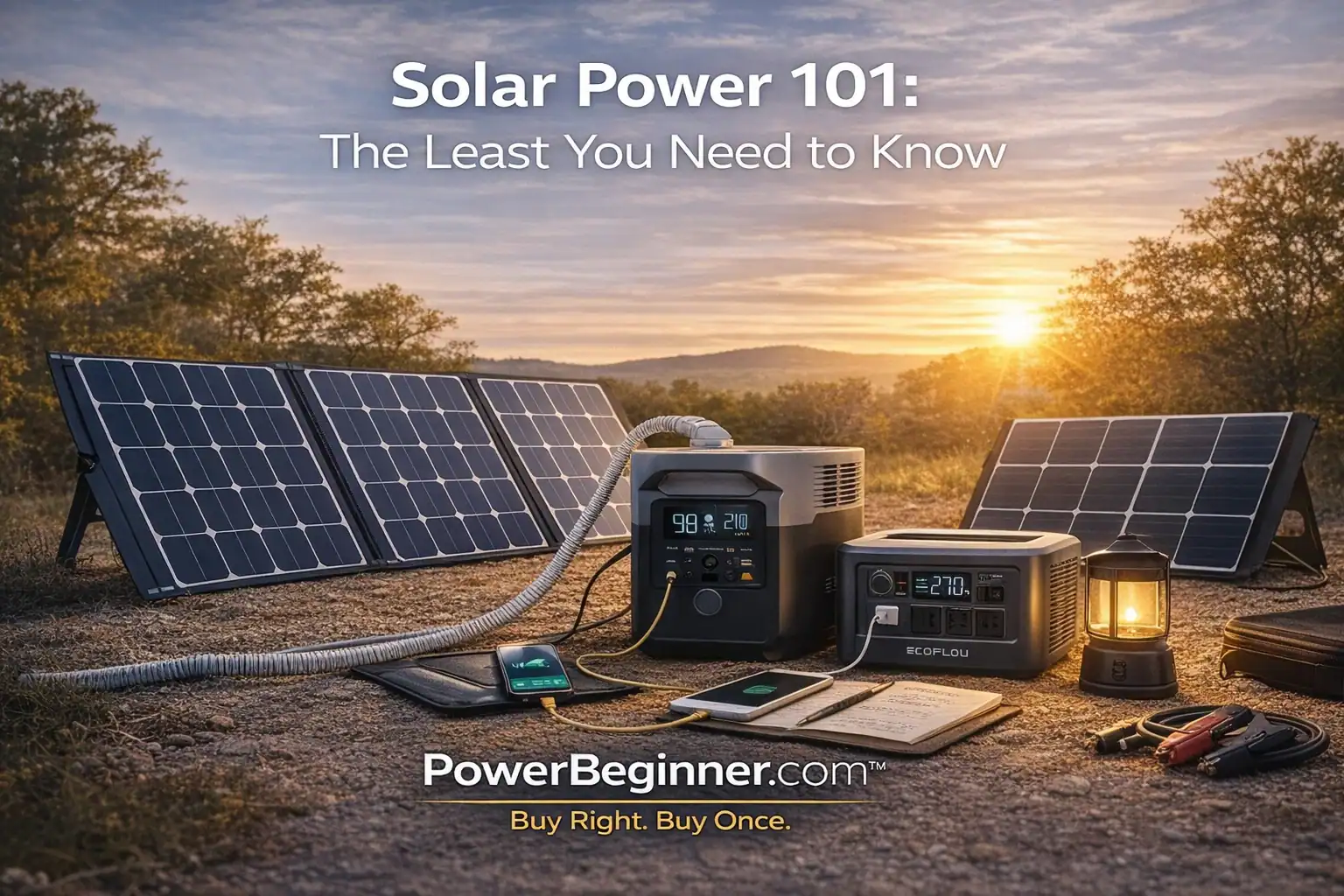
Solar power captures sunlight and converts it to electricity. For backup power purposes, this usually means portable solar panels charging power stations or batteries—not the rooftop installations that power entire homes. This guide focuses on portable solar for emergency preparedness, camping, and off-grid situations.
The Least You Need to Know
If you read nothing else, understand these fundamentals.
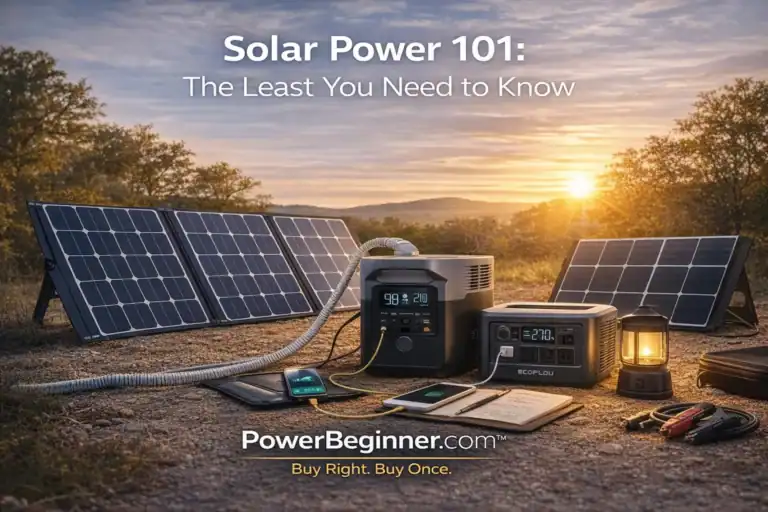
Solar panels convert sunlight to electricity. Photovoltaic cells in the panel absorb light energy and release electrons, creating electrical current. No moving parts, no fuel, no noise. Just sunlight in, electricity out.
Panel wattage is rated under ideal conditions. A “200W” panel produces 200 watts only in perfect laboratory conditions—direct overhead sun, optimal temperature, clean panel surface. Real-world output runs 60-80% of rated capacity. Expect 120-160 watts from a 200W panel in good field conditions.
You need something to store the electricity. Solar panels produce power only when the sun shines. To use solar power at night or during cloudy periods, you need batteries or a power station to store energy generated during sunny periods.
More panels = faster charging, not more total power. Adding panels speeds up how quickly you charge your battery. It doesnt give you more stored energy than the battery can hold. A 200W panel and a 400W array both fully charge the same battery—the 400W array just does it twice as fast.
Weather dramatically affects output. Clouds reduce output by 50-90%. Rain, snow, and shade can reduce output to near zero. Solar works great in sunny climates and seasons but becomes unreliable in cloudy conditions.
Angle and orientation matter. Panels produce maximum power when pointed directly at the sun. Fixed panels produce less than optimally angled panels. For portable use, adjusting panel angle throughout the day improves output.
Solar is slow compared to wall charging. Even large panel arrays take most of a sunny day to fully charge a power station. Wall charging takes 1-3 hours. Solar supplements other charging methods rather than replacing them for most users.
Temperature affects performance. Solar panels actually work better in cold weather (the cells, not the sunlight). Hot panels lose efficiency. A panel on a cool sunny morning outperforms the same panel on a hot afternoon.
Thats it. Those eight concepts cover what most beginners need. Everything below expands on these fundamentals for those wanting deeper understanding.
Deeper Dive
How Solar Panels Work
Solar panels use the photovoltaic effect—a phenomenon discovered in 1839 where certain materials generate electrical voltage when exposed to light.
The basic process:
- Sunlight hits the solar panel surface
- Photons (light particles) are absorbed by semiconductor material (usually silicon)
- Absorbed energy frees electrons from their atoms
- Freed electrons flow through the material as electrical current
- Metal contacts on the panel collect this current
- The current flows to whatever device or battery is connected
What the panel produces:
Solar panels generate DC (direct current) electricity—the same type stored in batteries. This makes them ideal for charging power stations and batteries directly. To power household devices that need AC (alternating current), you need an inverter to convert the power.
Panel construction:
A typical solar panel consists of:
- Glass or plastic front surface (protects cells, allows light through)
- Photovoltaic cells (the actual electricity generators)
- Back sheet (protection and insulation)
- Frame (structural support, usually aluminum for portables)
- Junction box (where electrical connections are made)
Portable panels often use folding designs with fabric hinges, allowing compact storage and transport while providing substantial surface area when deployed.
Types of Solar Panels
Three main technologies exist, each with tradeoffs.
Monocrystalline Silicon Made from single-crystal silicon, these panels are the most efficient and most common in quality portable panels.
Characteristics:
- 18-22% efficiency (highest)
- Black or dark blue appearance
- Best performance in limited space
- Highest cost per watt
- Best low-light performance
Best for: Portable panels where space and weight matter, maximum output from limited area
Polycrystalline Silicon Made from multiple silicon crystals melted together. Slightly less efficient but more affordable.
Characteristics:
- 15-18% efficiency
- Blue speckled appearance
- Good balance of cost and performance
- Slightly larger for same output as monocrystalline
Best for: Fixed installations where space isnt limited, budget-conscious buyers
Thin-Film (Amorphous) Made by depositing thin photovoltaic material on flexible backing. Least efficient but most flexible physically.
Characteristics:
- 10-13% efficiency
- Can be flexible and lightweight
- Works better in partial shade
- Degrades faster than crystalline types
- Requires much more area for same output
Best for: Curved surfaces, extreme portability needs, partial shade situations
For portable backup power: Monocrystalline panels dominate because they provide the most power per pound and per square foot—critical factors for equipment you carry and deploy.
Understanding Panel Specifications
Solar panel specs can confuse beginners. Heres what the numbers mean.
Wattage (W) The maximum power output under Standard Test Conditions (STC): 1,000 W/m² of sunlight, 25°C cell temperature, specific light spectrum. This is the headline number—a “200W panel” can produce up to 200 watts.
Real-world output: Expect 60-80% of rated wattage in good field conditions due to less-than-ideal sun angle, temperature effects, and environmental factors.
Voltage (V) The electrical pressure the panel produces. Common ratings:
- 18-22V: Designed for 12V battery systems (charging voltage exceeds battery voltage)
- 36-40V: Designed for 24V systems or series connection
- Open Circuit Voltage (Voc): Maximum voltage when nothing is connected
- Maximum Power Voltage (Vmp): Voltage at peak power output
For portable power stations, verify your panel’s voltage matches the station’s input range. Most stations accept 12-48V input; most portable panels output 18-22V.
Current (A) The electrical flow the panel produces. Combined with voltage, this determines wattage (W = V × A).
- Short Circuit Current (Isc): Maximum current when outputs are connected directly
- Maximum Power Current (Imp): Current at peak power output
Efficiency (%) What percentage of sunlight hitting the panel converts to electricity. Higher efficiency means more power from the same size panel. Premium monocrystalline panels achieve 20-22%; budget panels may be 15-17%.
Temperature Coefficient How much output decreases as temperature increases. A typical coefficient of -0.4%/°C means the panel loses 0.4% output for every degree Celsius above 25°C. At 45°C (113°F), output drops about 8% below rated capacity.
Portable Panel Configurations
Portable solar panels come in several form factors.
Folding Suitcase Panels Rigid panels with hinges, folding like a suitcase for transport. When deployed, they stand at adjustable angles for sun tracking.
Pros: Durable, good efficiency, adjustable angle Cons: Heavier, bulkier when folded, harder to pack
Folding Fabric Panels Flexible panels sewn into fabric backing, folding many times for compact storage.
Pros: Lightweight, very compact, easy to pack Cons: Less durable, lower efficiency, cant self-stand
Rollable Panels Thin-film technology allowing panels to roll up like a poster.
Pros: Most compact storage, lightweight Cons: Lowest efficiency, shorter lifespan, requires mounting/hanging
Rigid Single Panels Traditional flat panels meant for semi-permanent mounting.
Pros: Most durable, highest efficiency, longest life Cons: Bulky, heavy, not truly portable
For most portable backup use: Folding suitcase panels with kickstands offer the best balance of efficiency, durability, and usability. They deploy quickly, stand independently, and provide good output.
Connecting Solar to Power Stations
Most portable power stations have dedicated solar inputs for easy connection.
Connection types:
MC4 Connectors The industry standard for solar connections. Weatherproof, locking connectors that click together. Most panels and stations use MC4 or adapters to MC4.
Anderson Powerpole Common on some power stations. Require adapter from MC4 if your panels use standard connectors.
Proprietary Connectors Some brands (notably Goal Zero and older Jackery) use proprietary connections. You may need brand-specific panels or adapters.
DC Barrel Plug Some smaller stations use simple barrel connectors. Verify polarity and voltage compatibility.
Before connecting:
- Verify voltage compatibility (panel output within station’s input range)
- Check maximum input wattage (dont exceed station’s solar input capacity)
- Use appropriate cables and connectors
- Connect station before exposing panels to sun (prevents voltage spikes)
Series vs Parallel connection:
When using multiple panels:
- Series connection (positive to negative) adds voltage while current stays the same
- Parallel connection (positive to positive, negative to negative) adds current while voltage stays the same
Match your connection method to your power station’s input requirements. Most stations work best with panels connected in series for higher voltage, but verify your specific station’s recommendations.
Sizing Your Solar Setup
Matching panel capacity to your power station and needs.
Basic rule: Panel wattage should roughly match your desired daily recharge capacity divided by 4-6 hours of effective sunlight.
Example calculation:
- Power station: 1,000 Wh capacity
- Goal: Full recharge in one sunny day
- Effective sun hours: 5 hours
- Panel need: 1,000 Wh ÷ 5 hours = 200W of effective output
- Accounting for real-world derating: 200W ÷ 0.75 = 267W rated panel capacity
A 300W panel array would reliably recharge a 1,000 Wh station in good conditions.
Panel sizing recommendations:
| Power Station Size | Minimum Panel | Recommended Panel |
|---|---|---|
| 250-500 Wh | 50-100W | 100-200W |
| 500-1,000 Wh | 100-200W | 200-400W |
| 1,000-2,000 Wh | 200-400W | 400W+ |
| 2,000+ Wh | 400W+ | 600W+ |
Factors affecting panel size choice:
- Charging speed priority: More panels = faster charging
- Portability priority: Fewer, smaller panels = easier transport
- Budget: Larger arrays cost more
- Available sunlight: Cloudy climates need more panel capacity
Dont oversize beyond station limits. Your power station has a maximum solar input (e.g., 400W). Connecting 600W of panels doesnt charge faster—the station only accepts what it can handle.
Maximizing Solar Output
Getting the most from your panels requires attention to several factors.
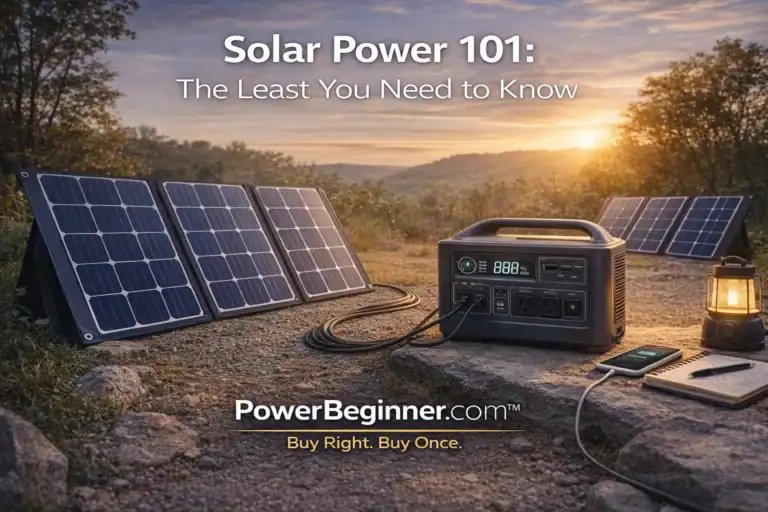
Angle optimization: Panels produce maximum power when perpendicular to sunlight. Throughout the day, optimal angle changes as the sun moves.
- Morning: Face panels east, steep angle
- Midday: Face south (in Northern Hemisphere), moderate angle
- Afternoon: Face west, steep angle
For stationary setups, aim for average best angle—typically latitude angle facing south for Northern Hemisphere locations.
Avoid shade: Even partial shade dramatically reduces output. A shadow covering 10% of a panel can reduce output by 50% or more due to how cells are wired. Position panels in full sun, away from trees, buildings, and other obstructions.
Keep panels cool: Hot panels lose efficiency. When possible:
- Allow airflow behind panels
- Avoid laying panels directly on hot surfaces
- Morning sun often produces more than afternoon sun (cooler temperatures)
Keep panels clean: Dust, dirt, pollen, and bird droppings reduce light reaching cells. Wipe panels with soft cloth and water as needed. Even light dust accumulation reduces output measurably.
Monitor and adjust: If possible, check output periodically and adjust panel angle to track the sun. Even crude adjustments every few hours improve daily energy harvest significantly.
Real-World Solar Performance
Setting realistic expectations prevents disappointment.
What “200W” actually produces:
Laboratory conditions (STC): 200W Real-world peak (perfect conditions): 160-180W Typical good conditions: 140-160W Partly cloudy: 60-100W Overcast: 20-40W Heavy clouds/rain: 5-20W
Daily energy harvest:
A 200W panel in good summer conditions might produce:
- Peak hours (4-5 hours): 600-800 Wh
- Shoulder hours (2-3 hours): 200-300 Wh
- Total daily harvest: 800-1,100 Wh
In winter or cloudy conditions, the same panel might produce:
- Peak hours (2-3 hours): 300-450 Wh
- Shoulder hours (2-3 hours): 100-200 Wh
- Total daily harvest: 400-650 Wh
Planning implications:
Dont rely on solar as your only charging option. Weather is unpredictable, and solar output varies dramatically by season and conditions. Solar works best as supplementary charging alongside wall or generator charging capability.
Solar for Emergency Preparedness
Solar fits into emergency power planning with appropriate expectations.
Strengths for emergencies:
- No fuel required (works when gas stations are closed)
- Silent operation (no attention from neighbors)
- Indefinite operation (sun keeps rising)
- Low maintenance (no engine to maintain)
- Portable (evacuate with your power system)
Limitations for emergencies:
- Weather dependent (storms often coincide with outages)
- Slow charging compared to grid power
- Requires daytime deployment and monitoring
- Limited output in winter months
- Theft risk when deployed outdoors
Practical emergency solar strategy:
- Keep power station fully charged normally (wall power)
- Use solar to extend runtime during extended outages
- Prioritize essential loads to match available solar generation
- Have generator backup for extended cloudy periods
- Store panels inside to prevent weather damage when not charging
Frequently Asked Questions
How many solar panels do I need? Match panel wattage to your power station’s capacity and your patience for charging time. For a 1,000 Wh station, 200W of panels provides full charge in a long sunny day. More panels charge faster but cost more and take more space.
Do solar panels work on cloudy days? Yes, but at greatly reduced output—typically 10-40% of full sun capacity depending on cloud thickness. Heavy overcast may produce only 5-10% of rated output. Dont rely on solar as sole charging method in cloudy climates.
How long do solar panels last? Quality panels last 20-25+ years, though output gradually decreases (typically 0.5-1% per year). After 20 years, a panel might produce 80-85% of original capacity. Portable panels may have shorter lives due to handling wear.
Can I leave solar panels outside permanently? Quality panels are weatherproof and designed for outdoor use. However, portable panels benefit from indoor storage when not actively charging—protecting from UV degradation, weather damage, and theft.
Do I need a charge controller? When connecting panels directly to a power station, the station’s internal circuitry handles charge regulation—no separate controller needed. For DIY battery systems, a charge controller is essential to prevent overcharging.
Can solar panels charge in winter? Yes. Cold temperatures actually improve panel efficiency. However, winter brings shorter days, lower sun angles, and often more clouds—reducing total energy harvest. Snow covering panels must be cleared for any output.
Are flexible panels as good as rigid panels? Flexible panels (thin-film) have lower efficiency and shorter lifespans than rigid crystalline panels. They’re useful for specific applications requiring flexibility but produce less power per square foot and degrade faster.
Last updated: February 2026. This guide is for educational purposes. Always follow manufacturer instructions.