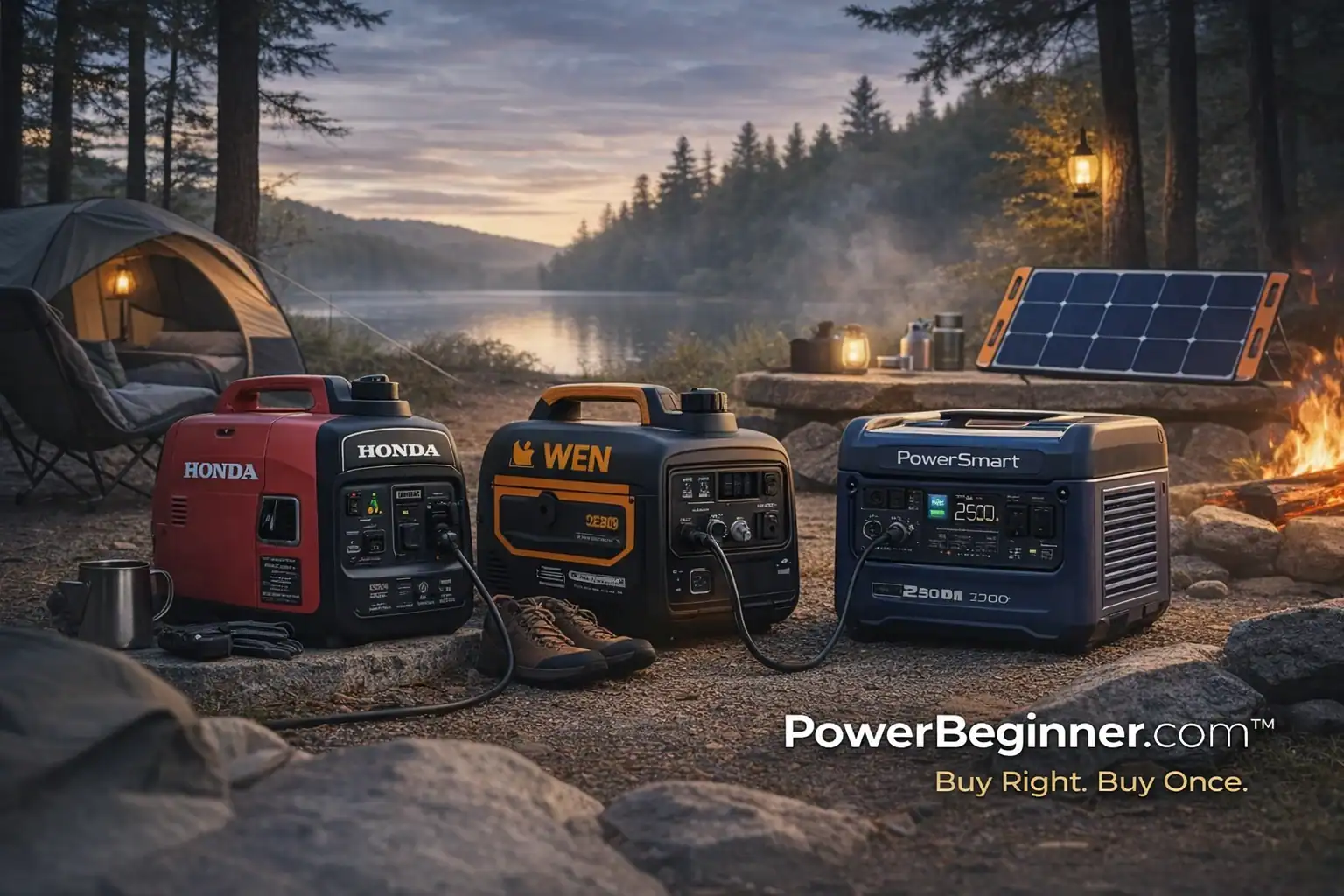
Quiet inverter generators that wont get you kicked out of the campground.
Camping with a generator used to mean choosing between convenience and campground harmony. Older generators were loud enough to announce your presence to everyone within a quarter mile. The noise defeated the purpose of escaping to nature.
Modern inverter generators changed everything. Quiet operation at 50-60 decibels means you can run your equipment without disturbing neighbors or attracting angry campground hosts. The technology has matured to the point where camping generators are genuinely pleasant to use.
The challenge now isnt finding a quiet generator—its finding the right balance of power, portability, and features for your specific camping style. Car camping, RV trips, and backcountry basecamp all have different requirements.
What Makes a Good Camping Generator
Before diving into specific models, understand what actually matters for camping use.
Quiet operation is non-negotiable. Most campgrounds enforce noise limits around 60-65 decibels. Inverter generators running 50-58 decibels pass easily. Conventional generators at 70-80 decibels will generate complaints or get you asked to leave.
Portability matters more than you think. A generator that’s too heavy to move easily will stay in your vehicle more often than you’d like. Consider weight alongside capacity when choosing.
Fuel efficiency extends trips. Eco-mode features that adjust engine speed to match load can double runtime on a tank of gas. For multi-day camping without resupply, this efficiency matters significantly.
Reliability trumps features. A generator that wont start reliably is worthless regardless of its specifications. Prioritize proven models with established track records.
Best Camping Generators
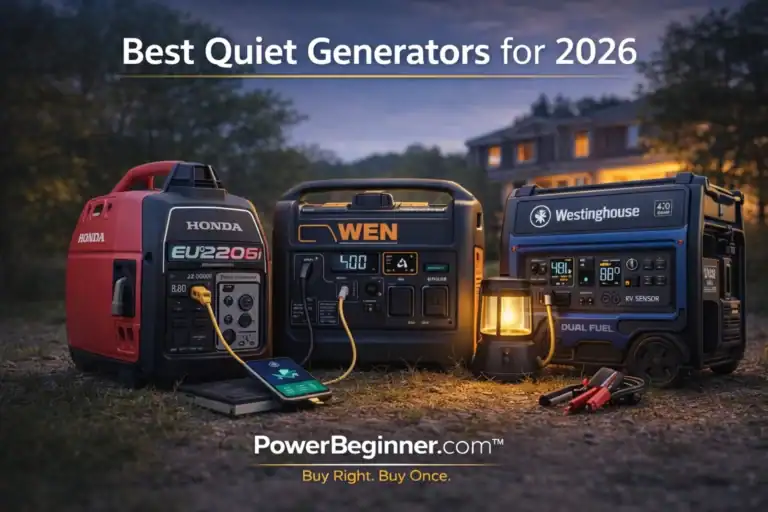
Best Overall: WEN 56225i 2250-Watt

- Dimensions: 19" x 11.5" x 18.2" | Weight: 48.5 lbs.Dimensions: 19" x 11.5" x 18.2" | Weight: 48.5 lbs
- Extremely quiet 53 dB operation comparable to the sound of a normal conversation according to the US Department of Health and Human Services
- EPA III and CARB-Compliant 79.7cc 4-Stroke OHV engine produces 2250 surge watts and 1800 rated watts
- Fuel shutoff maximizes the generator’s lifespan by using up the remaining fuel in the carburetor before shutting down
- Produces clean power to safely operate and prevent damage to sensitive electronics such as phones, tablets, televisions and computers

The WEN 56225i hits the sweet spot for most campers. At 2,250 starting watts, 1,850 running watts, and around $535, it delivers clean inverter power at a price that doesnt sting.
The fuel shutoff feature prevents carburetor gumming during storage between camping trips—the single most valuable maintenance feature for occasional-use generators. Eco-mode adjusts engine speed to match load for better fuel efficiency and reduced noise.
At 48 pounds, its light enough for one person to handle. The 51-57 decibel operation keeps noise campground-friendly. CARB compliant for use in all 50 states.
Over 5,200 reviews at 4.5 stars makes this one of the most proven camping generators on the market.
Best Premium: Honda EU2200i
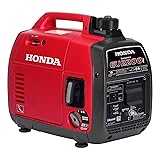
- This popular model can operate a wide variety of appliances, making it perfect for portable use at home, camping, on the job site, or much more. Reliable Power is now at your fingertips with Honda's Inverted Generators.
- So quiet, your neighbors will thank you. The EU2200i operates at 48 to 57 dBA, which is less noise than a normal conversation. This makes it ideal for camping, supplemental RV power and any other activity that requires quiet operation.
- Add a second EU2200i for additional power. Two identical models can be paralleled with an optional cable or cord for up to 4400 watts of power, or time-consuming applications.
- Thanks to our exclusive Eco-Throttle System, the EU2200i offers great fuel efficiency. Runs 4.0 to 9.6 hours on a single tank, depending on the load. This makes it the ideal choice for overnight power, or long-time applications.
- Honda's inverter technology means stable, clean power in a smaller, lighter package. The precision of Honda's inverter technology ensures our inverter generators produce power that is as reliable as the power you get from your outlets at home.
When reliability cannot fail and budget allows, the Honda EU2200i sets the standard. At 2,200 starting watts and 1,800 running watts, the capacity matches most competitors. The difference is legendary durability that routinely delivers 15-20 years of service.
Honda invented the portable inverter generator category. Every other manufacturer is essentially trying to match what Honda established decades ago. The EU2200i represents their current refinement of that original concept.
At 48-57 decibels, the quiet operation rivals any competitor. The CO-Minder provides automatic shutoff for safety. The 46-pound weight makes it genuinely portable.
Over 2,000 reviews at 4.8 stars with complaints focused on price rather than performance.
Best Value: WEN 56200i 2000-Watt

- Dimensions: 18" x 11" x 18" | Weight: 48 lbs
- Noise Level: 53 dB operation
- EPA III and CARB Compliant 79.7 cc 4-stroke OHV engine produces 2000 surge watts and 1600 rated watts
- Great for campgrounds, construction sites, tailgates and power outages
- Produces clean power to safely operate and prevent damage to sensitive electronics such as phones, tablets, televisions and computers
For campers focused on budget, the WEN 56200i delivers 2,000 starting watts and 1,600 running watts at around $490. The reduced capacity handles most camping needs—phone charging, lights, small appliances, CPAP machines.
Same fuel shutoff feature and build quality as larger WEN models. The 51-57 decibel operation keeps things quiet. At 48 pounds, portability matches premium competitors.
The 1-gallon fuel tank runs approximately 6 hours at half load—adequate for typical camping where you’re not running the generator continuously.
Over 5,200 reviews at 4.5 stars across years of market presence.
Best Dual Fuel: WEN DF360iX 3600-Watt
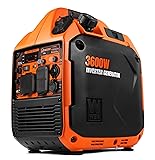
- Dual-fuel design runs on both gasoline (3600 surge watts, 2900 rated watts) and propane (3500 surge watts, 2600 rated watts)
- Extremely quiet operation comparable to the sound of a normal conversation according to the US Department of Health and Human Services
- Produces clean power to prevent damage to sensitive electronics such as smartphones, tablets and laptops
- The WEN Watchdog CO Shutdown Sensor helps protect both you and your family by automatically turning off the generator if dangerous levels of carbon monoxide are detected
- Includes fuel shut-off to help limit maintenance, two three-prong 120V receptacles, one TT-30R RV receptacle, one 12V DC receptacle, two 5V USB ports, a tool-free LPG quick-connector, and a three-year warranty
Dual fuel capability adds propane as an alternative to gasoline. In fire-restricted areas where gasoline generators may be prohibited, propane generators often remain permitted. The fuel flexibility provides options other camping generators lack.
At 3,600 starting watts and 2,800 running watts, the capacity handles larger loads than typical 2,000-watt camping generators. Run a small AC unit, multiple devices, or power tools at your campsite.
The inverter technology keeps power clean for electronics. The weight increases to match the extra capacity, but remains manageable for camping use.
957 reviews at 4.5 stars from campers who value the fuel flexibility.
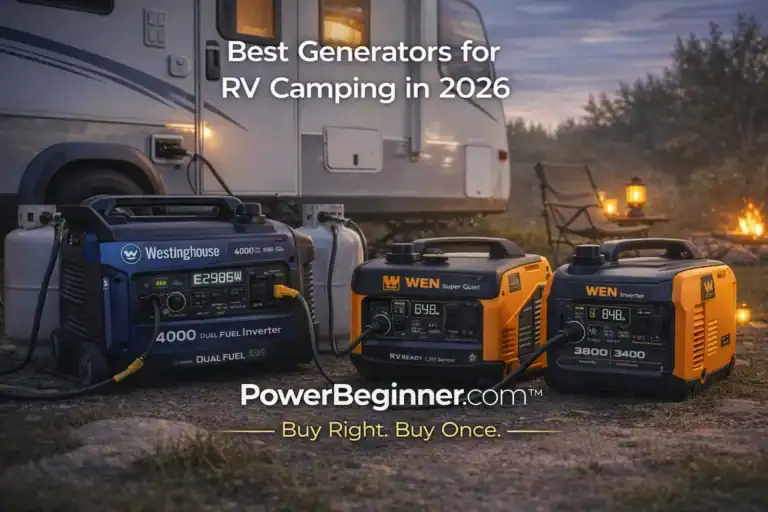
Best for RV Camping: WEN 56380i 3800-Watt

- Extremely quiet operation minimizes noise; EPA III Compliant
- 212cc 4-stroke OHV engine produces 3800 surge watts and 3400 rated watts with a half-load runtime of up to 8.5 hours
- Fuel shutoff maximizes the generator’s lifespan by using up the remaining fuel in the carburetor before shutting down
- Produces clean power to prevent damage to sensitive electronics such as smart phones, tablets and laptops
- Includes two three-prong 120V receptacles, one AC 120V NEMA TT-30R RV receptacle, one 12V DC receptacle, one 5V USB port, a digital load and fuel display, and a two-year warranty
RV camping has specific requirements—primarily the ability to run air conditioning. The WEN 56380i delivers 3,800 starting watts, enough to start most 13,500 BTU RV air conditioners.
Electric start eliminates pull-cord hassles on a generator you might use daily during trips. The RV-ready 30A outlet connects directly to your RV without adapters. The wheel and handle kit makes the 99-pound weight manageable.
Over 3,000 reviews at 4.59 stars from RV owners who’ve tested this generator through countless camping trips.
Best Power Station Alternative: Jackery Explorer 1000 v2
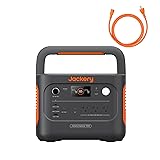
- Powerful & Compact: 1,500W AC output with 3,000W surge peak powers appliances like AC units, fridges, and electric pots. With a 1,070Wh capacity, lightweight design (23.8 lbs), and foldable handle, it's ideal for camping, road trips, or emergencies.
- Ultra-Fast Charging (1 Hour): Fully charge from 0% to 100% in just one hour using emergency mode activated through the Jackery App. Default 1.7-hour charge optimizes battery lifespan. Equipped with advanced ChargeShield 2.0 technology for safer, smarter charging.
- Long-lasting Battery Life: Durable LFP battery retains over 70% capacity after 4,000 charge cycles, providing a lifespan of over 10 years.
- Versatile Power Options: Includes 3 pure sine wave AC outlets, 2 USB-C ports (PD 100W), 1 USB-A port, 1 DC car port, and LED lights, allowing simultaneous device charging for multiple scenarios without additional adapters.
- Smart App Control: Easily manage charging modes via the Jackery App—choose between rapid emergency charging, quiet overnight charging (30 dB), or energy-saving modes tailored to your specific needs.
When weight matters most or you need silent operation, consider a power station instead of a generator. The Jackery Explorer 1000 v2 delivers 1,070 Wh of completely silent, emission-free power.
No engine means no noise, no fumes, and no fuel to manage. Charge from your vehicle, a wall outlet before departure, or solar panels at camp. Use inside your tent without any concerns about carbon monoxide.
At 1,500W output, the capacity exceeds many portable generators for typical camping loads. The LiFePO4 battery provides 3,000+ charge cycles of longevity.
For phone charging, laptop power, lights, fans, and small devices, a power station often serves camping needs better than a gas generator—especially for tent campers who value silence.
Best Budget Dual Fuel: Champion 4375

- Your purchase includes One Champion 3500-Watt Dual Fuel RV Ready Portable Generator and One LPG Hose with Regulator
- Portable Generator dimensions – 23.2” L x 19.1" W x 20" H | Product weight – 104.9 lbs. | Hose length – 3.3’
- Specifications: Noise level – 68 dBA. Fuel tank capacity (GASOLINE) – 3.4 gallons | Engine Size 224cc
- Operate your 3500-watt portable generator right out of the box on either gasoline or propane, plus the unit holds 0.6-quarts of oil and has a low oil shut-off sensor
- Keep track of voltage, hertz and run-time hours to easily monitor power output and track maintenance intervals with Intelligauge
For campers who prioritize capacity and value over minimal noise, the Champion 4375 delivers 4,375 starting watts at around $510. The dual fuel capability adds propane flexibility.
This is a conventional generator, not an inverter. At 68 decibels, its louder than inverter alternatives but still acceptable for most camping situations, especially dispersed camping away from neighbors.
The extra capacity handles larger loads—power tools, multiple devices, small AC units. For campers who need more power than typical 2,000-watt units provide, the Champion delivers.
891 reviews at 4.59 stars from budget-conscious campers.
Power Requirements for Camping
Understanding your actual needs prevents buying too much or too little generator.
Basic tent camping:
- Phone/tablet charging: 20-50W
- LED lights: 10-25W
- Portable fan: 20-50W
- CPAP machine: 30-60W
- Total: 80-200W typical
A 2,000-watt generator is massive overkill for basic tent camping. Consider a power station instead.
Car camping with more equipment:
- Above basics: 80-200W
- Electric cooler: 40-60W
- Small TV: 50-100W
- Blender/coffee maker: 300-500W (brief use)
- Total: 200-500W typical, occasional spikes to 800W
A 2,000-watt inverter generator handles this comfortably.
RV camping:
- Above basics: 200-500W
- RV air conditioner: 1,200-1,500W running, 2,500-3,500W starting
- Microwave: 600-1,200W
- Total: Variable, with occasional high spikes
A 3,000-4,000 watt generator handles most RV needs.
Campground Etiquette
Generator use requires consideration for other campers. Follow these guidelines to avoid problems.
Observe quiet hours. Most campgrounds restrict generator use during evening and early morning hours—typically 8 PM to 8 AM. Run your generator during permitted hours and plan activities accordingly.
Position thoughtfully. Place your generator as far from neighboring sites as practical. Point the exhaust away from occupied areas. Use natural terrain features to block noise when possible.
Don’t run unnecessarily. Running a generator just to have it running annoys everyone. Use it when you need power, then shut it down. Your neighbors will appreciate the consideration.
Respond to complaints graciously. If someone asks you to reduce generator noise, work with them rather than becoming defensive. A generator-free camping experience is what many people are seeking.
Maintenance for Camping Generators
Generators used for camping face specific challenges from intermittent use and transport.
Run the carburetor dry before storage. Use the fuel shutoff feature to let the engine consume carburetor fuel before the last shutdown of each trip. This prevents the carburetor gumming that causes most storage-related problems.
Use fuel stabilizer. If you keep fuel in the generator between trips, add stabilizer to prevent degradation. Better yet, drain the tank or run it dry for storage.
Check oil before each trip. Oil can settle or drain during transport and storage. A quick dipstick check before starting prevents damage from low oil operation.
Inspect after transport. Check for loose connections, fuel leaks, or damage from vibration during travel. Address issues before you need the generator to work.
Run monthly even when not camping. Starting the generator and running it under load for 15-20 minutes monthly maintains reliability for when you need it. Generators that sit unused for months often refuse to start.
Frequently Asked Questions
How quiet is quiet enough for camping?
Most quality inverter generators run 50-58 decibels at rated load—comparable to normal conversation. This level is acceptable at most campgrounds and rarely generates complaints when used during permitted hours.
Can I run a camping generator overnight?
Most campgrounds prohibit generator use during quiet hours (typically 8 PM to 8 AM). Check campground rules before planning overnight generator use. For continuous power needs, consider a power station for overnight use and generator for daytime.
What size generator do I need for tent camping?
Most tent camping needs can be met with 1,000-2,000 watts, or even a power station in the 500-1,000 Wh range. Unless you’re running power tools or large appliances, a compact inverter generator provides plenty of capacity.
Are generators allowed in national parks?
Generator policies vary by park and campground. Many national park campgrounds allow generators during specific hours. Check the specific park’s regulations before arriving. Some primitive camping areas prohibit generators entirely.
Should I buy a generator or power station for camping?
For basic device charging and light use, a power station is often better—silent, emission-free, usable inside your tent. For running larger loads like RV air conditioning or power tools, generators provide more capacity. Many campers own both.
How do I transport a generator safely?
Transport generators upright when possible. Secure them to prevent movement during travel. Let the engine cool before loading in an enclosed vehicle. Never transport with fuel in enclosed spaces due to fume hazards.
Can I use my camping generator for home backup?
Yes, though camping generators typically have less capacity than dedicated home backup units. A 2,000-3,000 watt camping generator handles basic essentials (refrigerator, lights, device charging) but cant power central AC or multiple large appliances.
Last updated: February 2026. Prices and availability subject to change. We may earn a commission from purchases made through links on this page.
Last update on 2026-03-02 / Affiliate links / Images from Amazon Product Advertising API