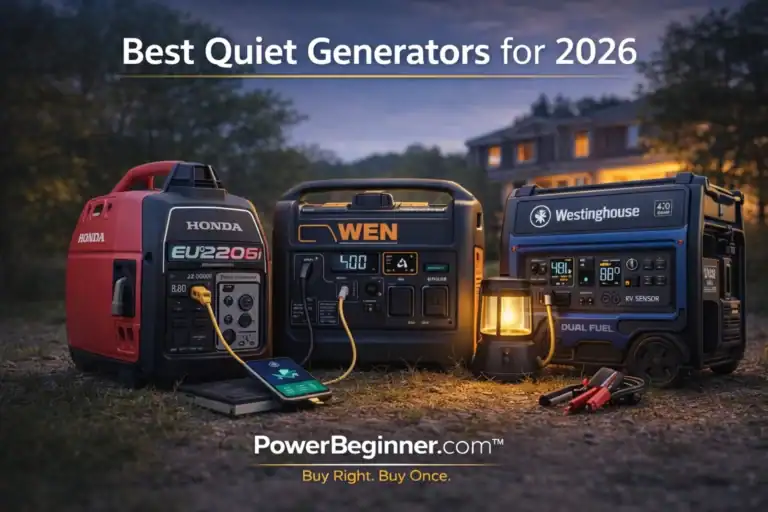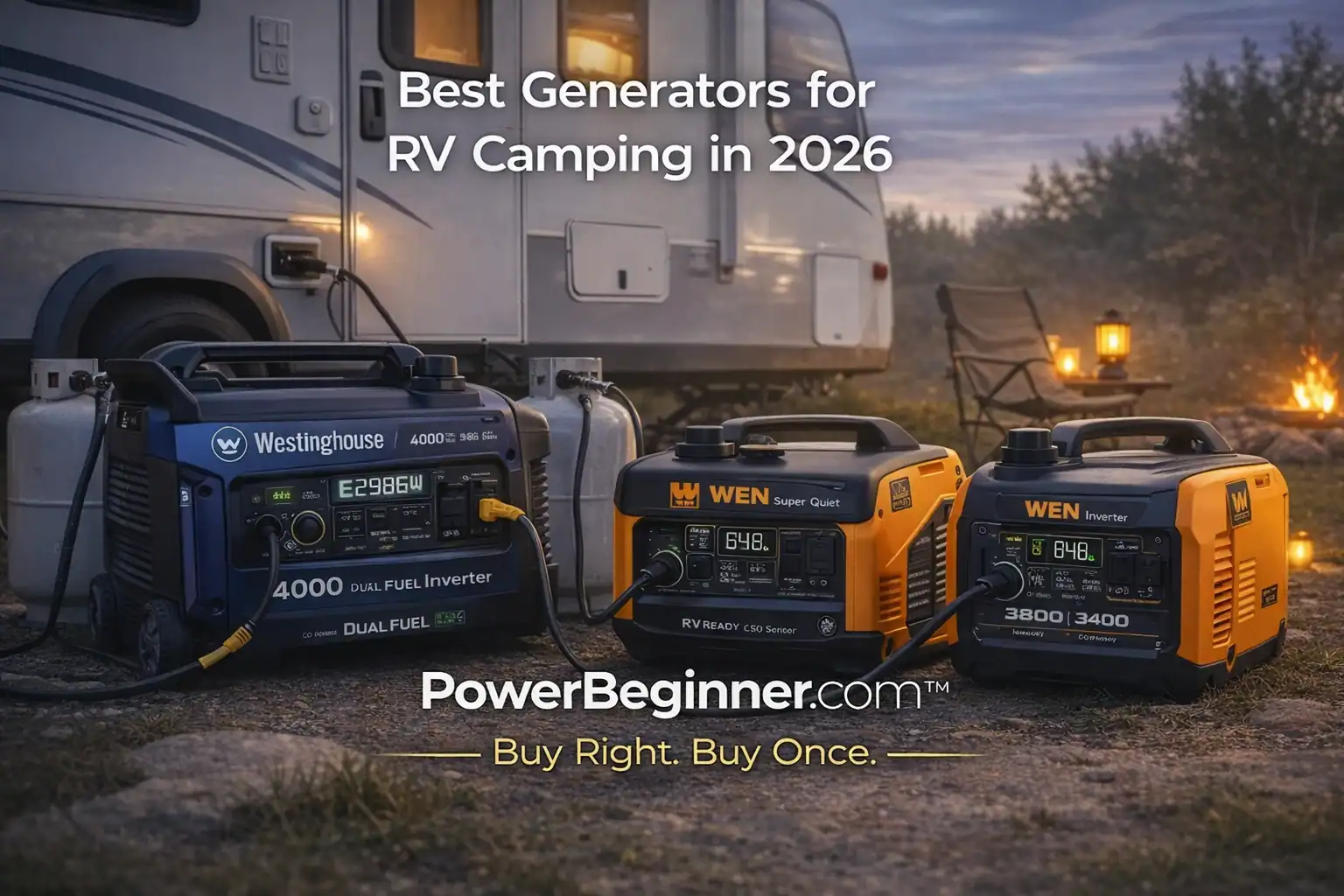
RV generators need to be quiet, powerful enough for AC, and built for frequent use. These models deliver on all three requirements.
RV camping without shore power means choosing between sweating through summer nights or running a generator. And if you’ve ever camped next to someone with a loud contractor-style generator hammering away at 80 decibels, you understand why your generator choice affects everyone around you.
The best RV generators balance three competing demands. Enough power to run your air conditioner. Quiet enough for campground use. Reliable enough to work every time you need it. Miss any one of these, and your generator becomes either inadequate, annoying, or expensive dead weight.
We’ve evaluated the RV generator market based on these practical requirements. What follows are our top recommendations for RV owners who want reliable power without campground drama.
RV Generator Requirements
Before choosing a generator, you need to understand what your RV actually requires.
Air conditioner starting load is the critical spec. Most RV air conditioners need 2,000-3,500 watts to start, then drop to 1,200-1,800 watts while running. A 13,500 BTU unit typically requires about 2,800-3,200 watts starting and 1,500 watts running. Your generator must handle that starting surge.
The 30A outlet matters. RVs use TT-30 connections for shore power. Generators with RV-ready 30A outlets connect directly without adapters. This isnt just convenience—adapters add connection points that can fail or overheat.
Noise levels affect everyone. Campground noise policies typically set 60-65 decibel limits at certain distances. Inverter generators running 50-60 dB pass easily. Conventional generators at 70-80 dB may generate complaints or require campground manager conversations you’d rather avoid.
Fuel efficiency determines runtime and refill hassle. Eco-mode features that adjust engine speed to match load can double runtime on a tank of gas while reducing noise. For multi-day camping without shore power, this efficiency matters significantly.
Best RV Generators
Best Overall: WEN 56380i 3800-Watt

- Extremely quiet operation minimizes noise; EPA III Compliant
- 212cc 4-stroke OHV engine produces 3800 surge watts and 3400 rated watts with a half-load runtime of up to 8.5 hours
- Fuel shutoff maximizes the generator’s lifespan by using up the remaining fuel in the carburetor before shutting down
- Produces clean power to prevent damage to sensitive electronics such as smart phones, tablets and laptops
- Includes two three-prong 120V receptacles, one AC 120V NEMA TT-30R RV receptacle, one 12V DC receptacle, one 5V USB port, a digital load and fuel display, and a two-year warranty

The WEN 56380i hits the sweet spot for most RV owners. At 3,800 starting watts and 3,400 running watts, it handles most RV air conditioners with capacity to spare. The inverter technology runs quiet enough for campground use without complaints.
Electric start eliminates pull-cord hassles on a generator you’ll use frequently during trips. The fuel shutoff feature prevents carburetor problems during storage between camping seasons. Wheel and handle kit makes the 99-pound weight manageable.
RV-ready 30A outlet connects directly to your RV. Parallel capability lets you add a second unit for larger RVs with multiple AC systems.
Over 3,000 reviews at 4.59 stars from RV owners who’ve tested this generator through countless camping trips.
Best Value: WEN DF360iX 3600-Watt Dual Fuel
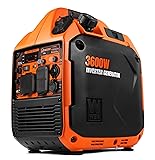
- Dual-fuel design runs on both gasoline (3600 surge watts, 2900 rated watts) and propane (3500 surge watts, 2600 rated watts)
- Extremely quiet operation comparable to the sound of a normal conversation according to the US Department of Health and Human Services
- Produces clean power to prevent damage to sensitive electronics such as smartphones, tablets and laptops
- The WEN Watchdog CO Shutdown Sensor helps protect both you and your family by automatically turning off the generator if dangerous levels of carbon monoxide are detected
- Includes fuel shut-off to help limit maintenance, two three-prong 120V receptacles, one TT-30R RV receptacle, one 12V DC receptacle, two 5V USB ports, a tool-free LPG quick-connector, and a three-year warranty
Add dual fuel capability at a competitive price point. The 3,600 starting watts handles most single-AC RV systems, and the propane option provides flexibility in areas with fire restrictions or uncertain fuel availability.
Propane burns cleaner than gasoline, reducing carburetor maintenance over time. In fire-restricted areas, propane may be permitted when gasoline generators are banned. The fuel flexibility adds practical value for RV use.
At around $485, this generator offers dual fuel inverter technology at prices typically reserved for gas-only units.
957 reviews at 4.5 stars. Strong value for budget-conscious RV owners who want fuel flexibility.
Best for Large RVs: Westinghouse 4000 Dual Fuel Inverter

- 4000 Peak Watts and 3300 Rated Watts at Less Than 3% THD – Telescoping Handle – Gas or Propane Powered – Remote Start With Included Key Fob, Electric and Recoil Start
- Features a 5–20R 120V Duplex Household Outlet, an RV-Ready TT-30R 30 Amp Outlet and Two USB Outlets – Great Choice for Travel Trailers or Home Use with Automatic Low Oil and Carbon Monoxide (CO) Shutdown – Strong Enough to Run All Your Essentials
- Led Data Center: Rotating Digital Display Shows Fuel Level, Power Output, Remaining Run Time, Voltage Output, and Lifetime Hours
- Extremely Quiet, Extremely Fuel Efficient: as Low as 52 dBA Noise Output and Up to 7 Hour Run Time on a 1.69 Gallon Gas Tank – Features “Economy Mode” for Maximum Fuel Efficiency
- All Westinghouse Portable Generators are Functionally Tested in the Factory and May Contain Minimum Residual Oil and/or Fuel Odor; EPA Compliant; Backed By 3-Year Limited Service, Labor, and Parts Coverage and Nationwide Customer Service Network
Larger RVs with 15,000 BTU air conditioners or dual-zone systems need more power than mid-size generators provide. The Westinghouse 4000 delivers 4,000 peak watts and 3,200 running watts—enough for larger AC systems with headroom for additional loads.
Remote electric start lets you fire up the generator from inside the RV rather than going outside. CO sensor provides safety shutoff. Parallel capability doubles capacity if you ever need even more power.
Over 2,200 reviews at 4.59 stars. RV owners consistently praise the combination of capacity, features, and quiet operation.
Best Premium Option: Honda EU2200i
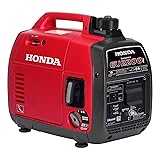
- This popular model can operate a wide variety of appliances, making it perfect for portable use at home, camping, on the job site, or much more. Reliable Power is now at your fingertips with Honda's Inverted Generators.
- So quiet, your neighbors will thank you. The EU2200i operates at 48 to 57 dBA, which is less noise than a normal conversation. This makes it ideal for camping, supplemental RV power and any other activity that requires quiet operation.
- Add a second EU2200i for additional power. Two identical models can be paralleled with an optional cable or cord for up to 4400 watts of power, or time-consuming applications.
- Thanks to our exclusive Eco-Throttle System, the EU2200i offers great fuel efficiency. Runs 4.0 to 9.6 hours on a single tank, depending on the load. This makes it the ideal choice for overnight power, or long-time applications.
- Honda's inverter technology means stable, clean power in a smaller, lighter package. The precision of Honda's inverter technology ensures our inverter generators produce power that is as reliable as the power you get from your outlets at home.
Honda invented the portable inverter generator category, and the EU2200i remains the benchmark for RV use. The 2,200 starting watts handles most 13,500 BTU RV air conditioners, and the legendary reliability means it will start every time.
At 48-57 decibels, this is one of the quietest generators available—important for campground harmony. The 46-pound weight makes it genuinely portable. CO-Minder provides automatic shutoff for safety.
The price premium over competitors is significant. But Honda generators routinely last 15-20 years, and resale value stays remarkably high. For full-time RVers or frequent travelers, the long-term value proposition can justify the upfront cost.
Over 2,000 reviews at 4.8 stars. The complaints focus on price, never performance.
Best Budget RV Generator: Champion 4375 Dual Fuel

- Your purchase includes One Champion 3500-Watt Dual Fuel RV Ready Portable Generator and One LPG Hose with Regulator
- Portable Generator dimensions – 23.2” L x 19.1" W x 20" H | Product weight – 104.9 lbs. | Hose length – 3.3’
- Specifications: Noise level – 68 dBA. Fuel tank capacity (GASOLINE) – 3.4 gallons | Engine Size 224cc
- Operate your 3500-watt portable generator right out of the box on either gasoline or propane, plus the unit holds 0.6-quarts of oil and has a low oil shut-off sensor
- Keep track of voltage, hertz and run-time hours to easily monitor power output and track maintenance intervals with Intelligauge
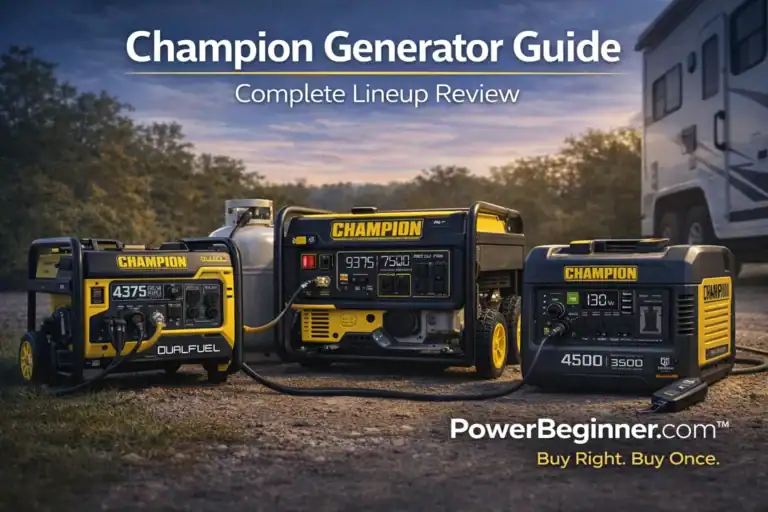
When budget matters more than whisper-quiet operation, the Champion 4375 delivers 4,375 starting watts at around $510. Thats enough power for most RV systems with significant capacity margin.
This is a conventional generator, not an inverter. Its louder at around 68 decibels—still acceptable for most campgrounds but noticeable compared to inverter models. For boondocking away from neighbors or campgrounds with relaxed noise policies, the extra noise rarely matters.
Champion’s Volt Guard surge protector helps protect RV electronics. The RV-ready 30A outlet connects directly. Dual fuel capability adds flexibility.
891 reviews at 4.59 stars from RV owners who prioritized value over minimal noise.
Best for Quiet Operation: Westinghouse 3700

- 3700 Peak Watts and 3000 Rated Watts at Less Than 3% THD – Telescoping Handle – Gas Powered – Weighs only 70.5 lbs
- Features a 5–20R 120V Duplex Household Outlet, an RV-Ready L5-30R 30 Amp Outlet and Two USB Outlets – Great Choice for Travel Trailers or Home Use with Automatic Low Oil and Carbon Monoxide (CO) Shutdown – Strong Enough to Run All Your Essentials
- Extremely Quiet, Extremely Fuel Efficient: as Low as 58 dBA Noise Output and Up to 8 Hour Run Time on a 1.3 Gallon Gas Tank – Features “Economy Mode” for Maximum Fuel Efficiency
- Plug-and-Play: Comes With Oil, an Oil Funnel, a Tool Kit, an L5-30R to TT-30R Adapter, Parallel Cords, and a User’s Manual to Get You Started Right Out of the Box (Minimal Assembly Required); EPA Compliant
- All Westinghouse Portable Generators are Functionally Tested in the Factory and May Contain Minimum Residual Oil and/or Fuel Odor; EPA Compliant; Backed By 3-Year Limited Service, Labor, and Parts Coverage and Nationwide Customer Service Network
When campground quiet hours matter or you’re camping near neighbors, the Westinghouse 3700 delivers 3,700 peak watts at just 52 decibels—among the quietest generators in its power class.
Remote electric start adds convenience. RV-ready 30A outlet connects directly. The wheel and handle kit makes the 74-pound weight manageable. CO sensor provides safety shutoff.
For RV owners who prioritize being good campground neighbors, the combination of adequate power and minimal noise makes this an excellent choice.
Nearly 8,000 reviews at 4.59 stars across years of consistent performance.
Best Parallel Setup: WEN 56225i x2

- Dimensions: 19" x 11.5" x 18.2" | Weight: 48.5 lbs.Dimensions: 19" x 11.5" x 18.2" | Weight: 48.5 lbs
- Extremely quiet 53 dB operation comparable to the sound of a normal conversation according to the US Department of Health and Human Services
- EPA III and CARB-Compliant 79.7cc 4-Stroke OHV engine produces 2250 surge watts and 1800 rated watts
- Fuel shutoff maximizes the generator’s lifespan by using up the remaining fuel in the carburetor before shutting down
- Produces clean power to safely operate and prevent damage to sensitive electronics such as phones, tablets, televisions and computers
For maximum flexibility, consider two smaller generators that can operate independently or together. A pair of WEN 56225i units provides 4,500 combined watts when paralleled, but each unit works alone for light loads.
Use one generator for quiet evening power—lights, TV, phone charging. Combine both when you need the air conditioner. Store both in spaces that couldnt fit a single large generator.
The approach costs slightly more than a single larger unit but provides redundancy. If one fails, you still have half your power capacity rather than nothing.
Over 5,200 reviews at 4.5 stars. The proven reliability makes parallel operation practical without worrying about mismatched units.
Understanding RV Air Conditioner Requirements
RV air conditioner specifications determine minimum generator requirements. Match your AC to adequate generator capacity:
| AC Rating | Starting Watts | Running Watts | Minimum Generator |
|---|---|---|---|
| 11,000 BTU | 2,000-2,400 | 1,000-1,200 | 2,500W |
| 13,500 BTU | 2,800-3,200 | 1,300-1,500 | 3,500W |
| 15,000 BTU | 3,300-3,800 | 1,500-1,800 | 4,000W |
These are approximate ranges. Actual requirements vary by AC model, age, and condition. Older or poorly maintained AC units may require more starting power. When in doubt, choose a generator with more capacity than the minimum.
Soft Start Devices: Reducing Required Capacity
Soft start devices reduce AC starting surge by 60-70%, allowing smaller generators to run larger air conditioners. A 13,500 BTU AC that normally requires 3,000+ starting watts might start with just 1,100-1,200 watts after soft start installation.
Popular soft start devices like the Micro-Air EasyStart cost $300-400 and require basic electrical knowledge to install. For RV owners with smaller generators, adding soft start to the AC may be more cost-effective than buying a larger generator.
The tradeoff is added complexity and installation cost. But the ability to run your AC on a smaller, quieter, lighter generator can be worth it for the right situation.
Generator Placement and Safety
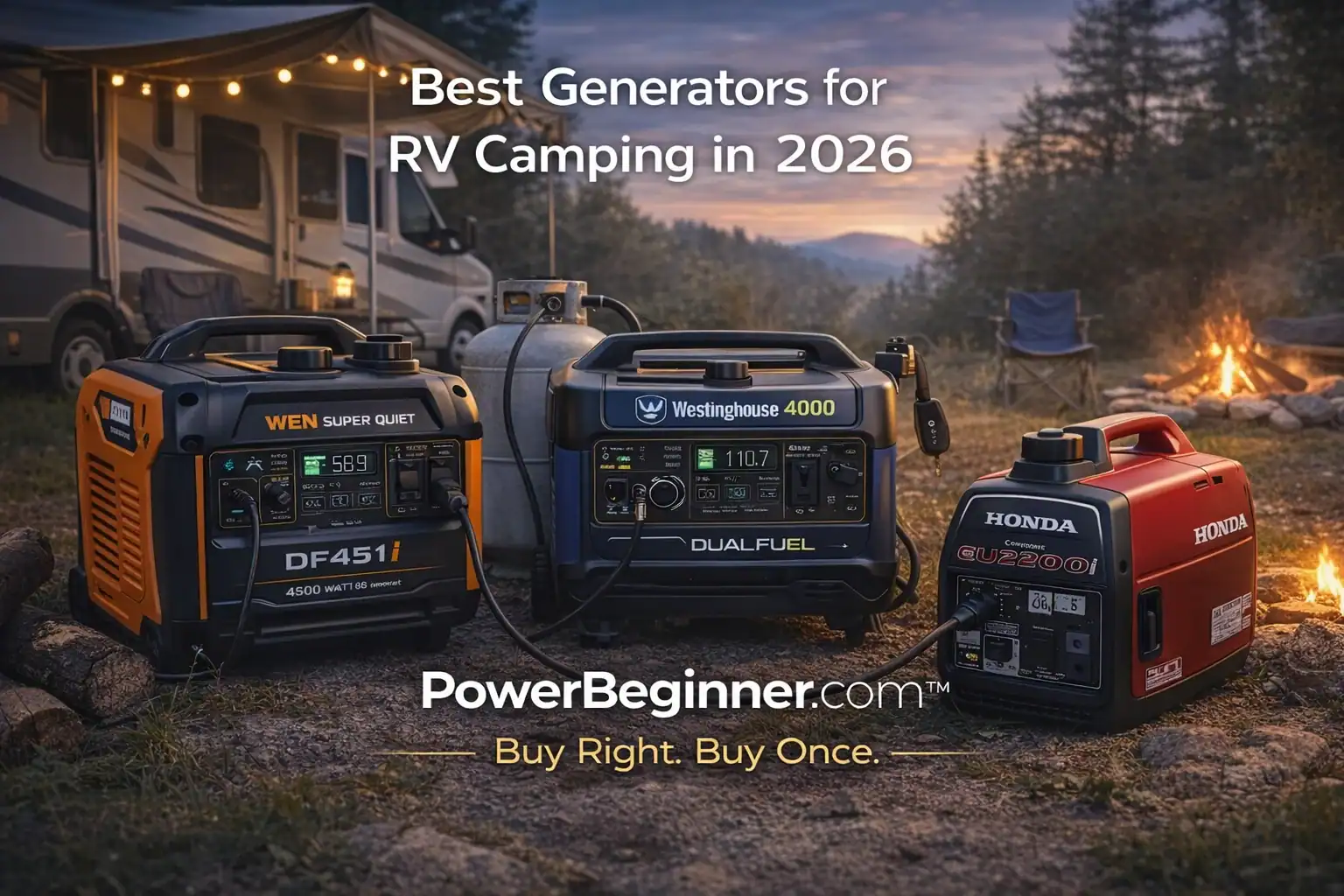
Never run a generator inside or under your RV. Carbon monoxide poisoning kills RV campers every year who thought ventilation was adequate. Position generators at least 10-15 feet from your RV with exhaust pointed away from all occupied areas.
Ground your generator properly if required. Many portable generators are designed with floating neutrals and dont require separate grounding for typical RV use. Check your generator’s manual and local campground requirements.
Secure generators against theft. RV campgrounds attract generator thieves who know exactly what they’re looking for. Use cable locks, lockable generator covers, or mount the generator in a secure compartment. At minimum, don’t leave expensive equipment visible and unsecured.
Monitor fuel levels and dont run dry. Running a generator until it runs out of fuel can damage the fuel system and leave you without power at the worst time. Refuel when the tank reaches 1/4 level.
Maintenance for RV Generators
RV generators sit unused for weeks between trips, then need to work perfectly when called upon. Proper maintenance ensures reliability.
Before each trip: Check oil level. Verify fuel is fresh (less than 30 days old without stabilizer). Test start the generator at home before leaving.
After each trip: Run carburetor dry using fuel shutoff feature. Store in a dry location. Top off fuel with stabilizer if storing more than a few weeks.
Periodically: Change oil every 50-100 hours or annually. Replace spark plug annually. Clean or replace air filter as needed. Check all connections for tightness.
The generators that fail at campsites are almost always units that sat neglected between trips. Ten minutes of pre-trip maintenance prevents hours of campsite frustration.
Frequently Asked Questions
Can I run my RV air conditioner on a 2000 watt generator? Most 13,500 BTU RV air conditioners require more than 2,000 watts to start. A 2,000 watt generator might run your AC after starting if you use a soft start device, but wont reliably start a standard AC compressor. For reliable AC operation without modifications, choose 3,000+ watts.
How long will a generator run my RV air conditioner? At typical loads, expect 6-10 hours of AC operation per tank of gasoline depending on generator size and fuel capacity. Hot days increase AC runtime, which increases fuel consumption. Carry adequate fuel for your planned off-grid duration.
Are inverter generators necessary for RVs? Inverter generators protect sensitive RV electronics and run much quieter than conventional generators. For campground use, the reduced noise alone justifies inverter technology. If you only boondock away from other campers, conventional generators work fine.
Can I connect two different generators in parallel? No. Parallel operation requires identical generators (or specifically compatible models from the same manufacturer). Mismatched generators produce power that conflicts rather than combines, potentially damaging both units and connected equipment.
Should I leave my generator running overnight? Most generators can run overnight if properly positioned for safety and noise. However, campground quiet hours typically restrict generator use after 8-10 PM. Many RV owners run the generator until bedtime to cool the RV, then let residual cooling carry through the night.
What size generator do I need for a 50 amp RV? 50 amp RVs can draw up to 12,000 watts, but rarely need that much at once. For running one AC and typical loads, 4,000-5,000 watts works. For two AC units, you need 7,000+ watts or parallel smaller generators. Evaluate your actual loads rather than maximum service capacity.
How do I connect a generator to my RV? Use the appropriate cord to connect the generator’s 30A RV outlet to your RV’s shore power inlet. Never backfeed through any other method. The RV’s electrical system is designed to accept power through the shore power connection.
Last updated: February 2026. Prices and availability subject to change. We may earn a commission from purchases made through links on this page.
Last update on 2026-03-02 / Affiliate links / Images from Amazon Product Advertising API