When the power goes out, everything stops. Your refrigerator. Your sump pump. Your medical equipment if you or someone in your family depends on it. And if you’ve ever sat through a multi-day outage in Texas summer heat or a northern winter freeze, you already know that “inconvenience” is a dramatic understatement.
Home backup generators aren’t cheap. But neither is a hotel room for a week, or replacing $400 worth of spoiled food, or dealing with burst pipes because your heating system went dark.
We spent three months researching the home backup generator market. We analyzed customer reviews, compared specifications, and looked at real-world performance data from owners whove used these machines during actual emergencies. What follows is our honest assessment of the best options available right now.
What Makes a Good Home Backup Generator
Before we get into specific models, lets talk about what actually matters when youre shopping for whole-house backup power.
Wattage matters, but not the way most people think. Manufacturers love to advertise peak watts, which is the maximum surge power a generator can produce for a few seconds. Running watts—the sustained power output—is what you actually live with. A generator rated at 12,500 peak watts might only deliver 9,500 running watts. Thats the number you need to match against your household requirements.
Fuel type affects everything. Gasoline generators are cheaper upfront but require fresh fuel and careful storage. Dual fuel models run on gas or propane, giving you options when one fuel source becomes scarce. Tri-fuel generators add natural gas to the mix, which means unlimited runtime if your home has a gas line.
Transfer switch compatibility is non-negotiable for serious home backup. You can plug individual appliances into a portable generator with extension cords. But if you want your generator to power your home’s electrical panel—furnace, well pump, refrigerator, and lights all working normally—you need a transfer switch. Look for “transfer switch ready” in the specifications.
Our Top Picks
Best Overall: Westinghouse 12500 Dual Fuel

- 9500 Running Watts and 12500 Peak Watts (Gasoline); 8500 Running Watts, 11200 Peak Watts (Propane); Remote Start with Included Key Fob, Electric and Recoil Start; Up to 12 Hours of Run Time on a 6. 6 Gallon Fuel Tank with Fuel Gauge
- Features Two GFCI 120V 5–20R 20A Standard Household Receptacle, One Transfer Switch Ready 120V L14-30R 30A, and One RV Ready 120/240V 14–50R 50A; All Outlets Have Rubber Covers for Added Safety
- Powered by a Heavy Duty 457cc Westinghouse 4-Stroke OHV Engine Featuring a Long-Lasting Cast Iron Sleeve with Automatic Low Oil and Carbon Monoxide (CO) Shutdown, and Digital Hour Meter
- Plug-and-Play: Comes with a Remote Start Key Fob, 12V Battery Charger, Oil, and Oil Funnel, a Tool Kit, and a User’s Manual to Get You Started Right Out of the Box (Minimal Assembly Required)
- All Westinghouse Portable Generators are Functionally Tested in the Factory and May Contain Minimum Residual Oil and/or Fuel Odor; EPA Compliant; Backed By 3-Year Limited Service, Labor, and Parts Coverage and Nationwide Customer Service Network

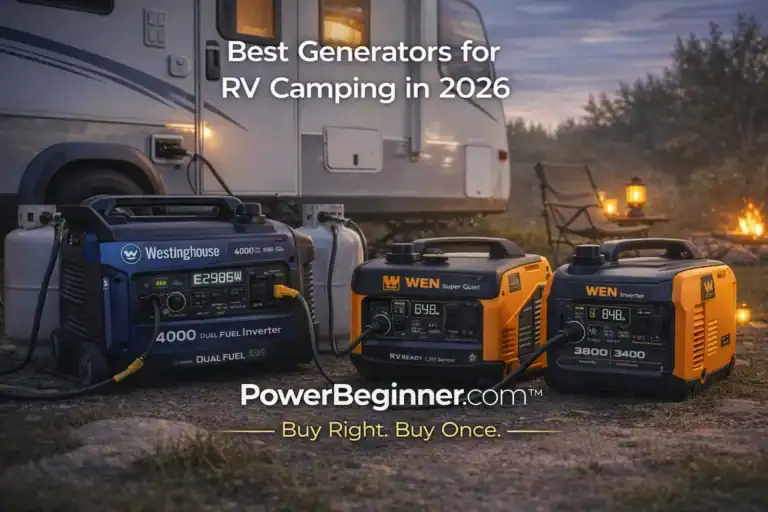
The Westinghouse 12500 has earned its reputation through sheer reliability. With 12,500 peak watts and 9,500 running watts on gasoline (11,200/8,500 on propane), this generator handles most homes without breaking a sweat.
What sets it apart is the combination of features at this price point. Remote electric start means you dont have to stumble outside in a storm to pull a cord. The digital display shows real-time voltage, frequency, and total runtime hours. Transfer switch ready out of the box.
Over 27,000 reviews averaging 4.7 stars tells you something. People buy this generator, use it during real emergencies, and come back to say it worked.
The 6.6-gallon fuel tank runs approximately 11 hours at 50% load on gasoline. Thats enough to get most families through a typical outage, and the dual fuel capability means you can switch to propane for extended events.
Premium Choice: Westinghouse 14500 Dual Fuel
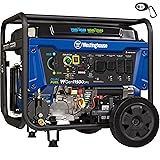
- Perfect as a backup power source for larger homes or a dependable source of portable power
- 14,500 peak watts, 11,500 running watts (gasoline); 13,500 peak watts, 10,500 running watts (propane)
- Runs for up to 19 hours on a 9.5 gal. fuel tank with built-in fuel gauge; up to 7 hours on a 20 lb. propane tank
- Powered by a heavy duty 550cc 4-Stroke OHV Westinghouse Engine constructed with a durable cast iron sleeve
- All Westinghouse Portable Generators are Functionally Tested in the Factory and May Contain Minimum Residual Oil and/or Fuel Odor; EPA Compliant; Backed By 3-Year Limited Service, Labor, and Parts Coverage and Nationwide Customer Service Network
If the 12500 feels like it might come up short for your needs, step up to the 14500. The extra 2,000 watts of peak power handles larger homes and more simultaneous loads without the generator struggling.
Same excellent build quality. Same remote start convenience. Same transfer switch ready design. Just more capacity for homes with central air conditioning, multiple refrigerators, or well pumps with high starting loads.
At around $1,349, its not cheap. But the cost difference between adequate power and insufficient power during an emergency is measured in different currency entirely.
Best Tri-Fuel Option: Westinghouse 12500 Tri-Fuel
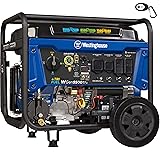
- 12500 Peak Watts, 9500 Running Watts (Gasoline); 11200 Peak Watts, 8500 Running Watts (Propane); 9500 Peak Watts, 7500 Running Watts (Natural Gas); Remote Start with Included Key Fob, Electric and Recoil Start; Up to 12 Hours of Run Time on a 6. 6 Gallon Fuel Tank with Fuel Gauge
- Features Two GFCI 120V 5–20R Standard Household Receptacle, One Transfer Switch Ready 120V L14-30R, and One RV Ready 120/240V 14–50R; All Outlets Have Rubber Covers for Added Safety
- Powered by a Heavy Duty 457cc Westinghouse 4-Stroke OHV Engine Featuring a Long-Lasting Cast Iron Sleeve with Automatic Low Oil and Carbon Monoxide (CO) Shutdown, and Digital Hour Meter
- Plug-and-Play: Comes with a Remote Start Key Fob, 12V Battery Charger, Oil, and Oil Funnel, a Tool Kit, and a User’s Manual to Get You Started Right Out of the Box (Minimal Assembly Required)
- All Westinghouse Portable Generators are Functionally Tested in the Factory and May Contain Minimum Residual Oil and/or Fuel Odor; EPA Compliant; Backed By 3-Year Limited Service, Labor, and Parts Coverage and Nationwide Customer Service Network
Natural gas changes the backup power equation completely. If your home has a gas line—and many do—a tri-fuel generator can run indefinitely during an extended outage. No gas cans to fill. No propane tanks to swap. Just flip a switch and let municipal gas keep you powered.
The Westinghouse 12500 Tri-Fuel delivers 12,500 peak watts on gasoline, 11,200 on propane, and 10,800 on natural gas. The slight reduction on alternative fuels is normal and still provides plenty of power for most households.
Installation requires a qualified technician to connect the natural gas line. This adds cost upfront but eliminates fuel logistics during emergencies—which is exactly when logistics become most difficult.
Best Value: Westinghouse 7500 EFI Dual Fuel

- FUEL FLEXIBILITY FOR HOME, RV & JOBSITE: 7,500 peak watts, 6,000 running watts (gasoline); 6,750 peak watts, 5,400 running watts (propane); runs for up to 14 hours on a 4.75 gal. fuel tank with built-in gauge, up to 9.5 hours on a 20 lb. propane tank; starting: remote key fob, electric and recoil
- MULTIPLE OUTLETS FOR MANY USES: Features one transfer switch ready L14-30R 120V/240V 30A twist lock for home backup; one TT-30R 120V 30A RV outlet; and one 5-20R 120V 20A duplex household outlet; all outlets include rubber covers for added protection
- DURABLE ENGINE WITH SAFETY BUILT-IN: Equipped with 298cc Westinghouse 4-stroke OHV engine with durable cast iron sleeve; automatic low oil shutdown; CO sensor for added safety
- ADVANCED EFI: Makes starting your generator as easy as starting a car, with no choke or carburetor to hassle with. Electronic fuel injection delivers higher power and torque, reduces fuel use and emissions, increases engine reliability, and needs less maintenance. Carb compliant in all 50 States
- POWER YOU CAN TRUST: All Westinghouse generators are functionally tested at the factory and may contain minimal residual oil or fuel odor and are backed by a 3-year limited warranty and our nationwide Westinghouse customer service network
Not every home needs 12,000+ watts. If your backup power plan focuses on essentials—refrigerator, freezer, some lights, phone charging, and maybe a window AC unit—the 7500 EFI handles that workload at a lower price point.
The EFI (Electronic Fuel Injection) system improves fuel efficiency and reduces maintenance compared to carbureted models. Easier starting in cold weather too, which matters if you live somewhere that actually experiences winter.
At 7,500 peak watts and 6,500 running watts on gasoline, this generator sits in the sweet spot for moderate power needs. The dual fuel capability adds flexibility without the complexity of tri-fuel systems.
Best for Whole-House Integration: Champion 9375 Dual Fuel
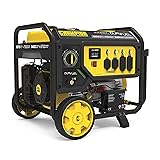
- DUAL FUEL: Operate your 7500-watt portable generator right out of the box on either gasoline or propane, plus the unit holds 1.2-quarts of oil (included) and has a low oil shut-off sensor
- ELECTRIC START: Power up the 439cc Champion engine with the handy rocker switch, battery included
- INTELLIGAUGE: Keep track of voltage, hertz and run-time hours to easily monitor power output and track maintenance intervals
- POWERFUL: At 9375 starting watts and 7500 running watts on gasoline and 8400 starting watts and 6750 running watts on propane, trust Volt Guard built-in surge protector to prevent overloads
- CHAMPION SUPPORT: Includes 3-year limited warranty with FREE lifetime technical support from dedicated experts
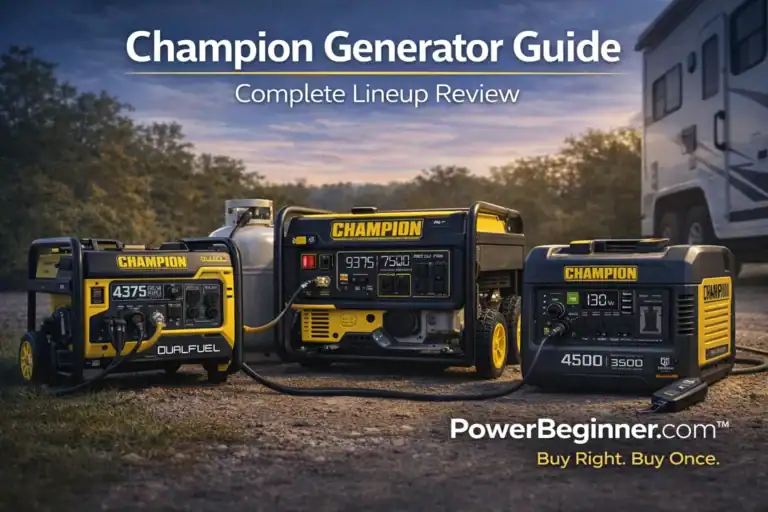
Champion has built a loyal following among homeowners who want serious capability without the premium brand markup. The 9375/7500 watt dual fuel model represents their sweet spot for home backup.
The Intelligauge digital display monitors voltage, hertz, and runtime hours. Electric start with included battery gets you running quickly. Champion’s Volt Guard protects connected equipment from power surges.
What really differentiates Champion is the 439cc engine and the company’s approach to customer support. Their technical support line actually answers. Their warranty claims get processed. These details matter when youre dealing with equipment failure during an emergency.
Sizing Your Generator Correctly
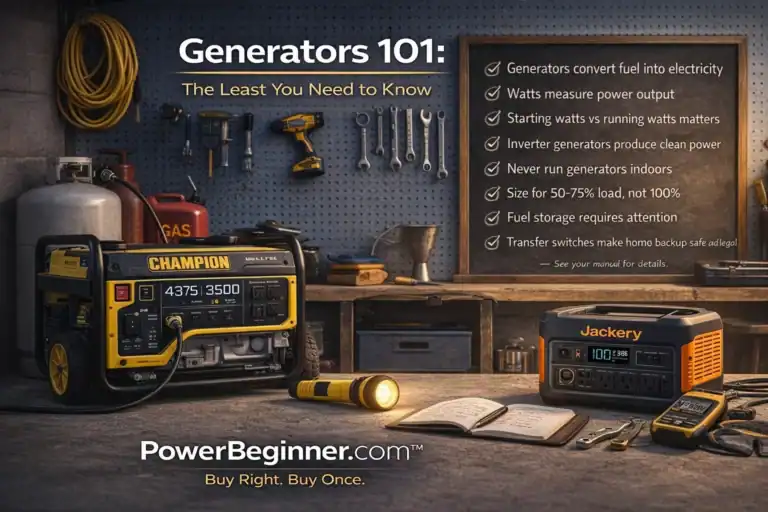
The biggest mistake people make is undersizing their generator to save money. Running a generator at 100% capacity continuously destroys it. You want your normal load to sit around 50-75% of rated capacity, leaving headroom for motor starting surges and unexpected additions.
Add up your essential loads:
- Refrigerator: 100-400 watts running, 1,200+ watts starting
- Freezer: 100-400 watts running, 1,200+ watts starting
- Sump pump: 800-1,000 watts running, 2,000+ watts starting
- Furnace blower: 300-500 watts running, 800+ watts starting
- Well pump: 700-1,500 watts running, 2,000-4,000 watts starting
- Window AC: 500-1,500 watts running, 1,500-3,000 watts starting
- Central AC: 2,000-4,000 watts running, 4,500-9,000 watts starting
Notice those starting watts. A well pump that runs at 1,000 watts might need 3,000 watts just to start. Your generator has to handle that surge, even briefly, or the motor wont start at all.
Most homes with a well pump, central AC, and typical appliances need a minimum of 7,500 running watts. Homes with larger AC systems or multiple high-draw appliances should look at 9,500+ running watts.
Fuel Storage and Safety
Gasoline degrades. Untreated gas starts breaking down within 30 days and becomes problematic for small engines within 3-6 months. If you’re storing gasoline for emergency use, treat it with a fuel stabilizer and rotate your stock every few months.
Propane doesn’t degrade and stores indefinitely in sealed tanks. This makes it ideal for emergency backup. A 20-pound propane tank (the standard grill size) powers most generators for 4-8 hours depending on load. Keep several tanks filled and ready.
Never run a generator indoors. Not in the garage. Not in the basement. Not even with the garage door open. Carbon monoxide poisoning kills people every year who thought they were being careful. Run your generator outside, at least 20 feet from windows and doors, with the exhaust pointed away from the house.
Installation Considerations
A portable generator with extension cords works for basic backup power. But for true whole-house backup that integrates with your electrical panel, you need professional installation.
Transfer switch options:
- Manual transfer switch: You physically flip breakers to switch between utility and generator power. Costs $200-500 for the switch plus installation.
- Automatic transfer switch: Senses utility power loss and switches to generator power automatically. Costs $500-2,000 plus installation. Requires a generator with electric start.
The transfer switch installation typically runs $500-1,500 depending on your panel’s complexity and local labor rates. This is not a DIY project unless you’re a licensed electrician. The consequences of mistakes range from fried appliances to house fires to electrocuting a utility worker.
Maintenance Requirements
Home backup generators sit unused for months, then need to work perfectly during an emergency. This only happens with proper maintenance.
Monthly: Start the generator and let it run under light load for 15-30 minutes. This circulates oil, burns off condensation, and keeps the carburetor from gumming up.
Annually: Change the oil. Replace the spark plug. Clean or replace the air filter. Check the fuel lines for cracks. Test the battery if equipped with electric start.
Before storm season: Run through your full startup procedure. Test the transfer switch if installed. Verify you have fresh fuel and the means to get more.
The generators that fail during emergencies are almost always the ones that sat untouched since the last emergency. Dont let yours become a very expensive lawn ornament.

Frequently Asked Questions
How long can I run a generator continuously? Most portable generators are designed for 8-12 hours of continuous operation before needing to cool down and refuel. Running continuously beyond manufacturer recommendations significantly shortens engine life. For multi-day outages, plan on cycling the generator with rest periods.
Can I connect a generator directly to my electrical panel? Never connect a generator directly to your panel without a transfer switch. This creates backfeed that can electrocute utility workers and damage equipment. Transfer switches isolate your home’s electrical system from the grid when generator power is active.
What size generator do I need for a 2,000 square foot house? Square footage alone doesn’t determine generator size—your electrical loads do. A 2,000 sq ft house with gas heating and no well pump might need only 5,000 watts. The same house with a well pump, electric heat, and central AC might need 12,000+ watts.
Are inverter generators better than conventional generators for home backup? Inverter generators produce cleaner power suitable for sensitive electronics, run quieter, and offer better fuel efficiency. However, they typically cost more per watt and most top out around 7,000 watts. For whole-house backup requiring 9,000+ watts, conventional generators remain the practical choice.
How much does professional generator installation cost? Installation costs typically range from $500-2,500 depending on the transfer switch type, panel complexity, and local labor rates. Automatic transfer switches cost more than manual switches. Expect the total installed cost to add 30-50% to the generator purchase price.
Do I need to ground my portable generator? Most modern portable generators are designed with a floating neutral and don’t require a separate ground rod for typical household backup use. However, if your local code requires grounding, or if you’re using the generator for construction sites or other specific applications, follow the manufacturer’s grounding instructions.
What’s the difference between CARB compliant and non-CARB generators? CARB (California Air Resources Board) compliant generators meet stricter emissions standards required for sale in California and several other states. If you live in a CARB state, you must purchase a compliant model. CARB models work fine in all states, so buying CARB compliant is never wrong.
Last updated: February 2026. Prices and availability subject to change. We may earn a commission from purchases made through links on this page.
Last update on 2026-03-02 / Affiliate links / Images from Amazon Product Advertising API