Everything beginners need to understand about power inverters for off-grid, RV, and backup power systems.
Your batteries store DC power. Your appliances need AC power. An inverter bridges that gap, converting the direct current from batteries into the alternating current that runs household devices.
Choosing the wrong inverter means either wasting money on capacity you dont need or damaging sensitive electronics with poor power quality. This guide explains what matters and what doesnt when selecting an inverter for your power system.
The Least You Need to Know (TLDR)
If you read nothing else, understand these eight points:
1. Pure sine wave inverters are worth the extra cost. Modified sine wave inverters cost less but can damage sensitive electronics and make motors run hot. Pure sine wave produces power identical to utility power.
2. Inverter size must exceed your peak load. A 2000W inverter runs 2000W of loads. But motors and compressors have startup surges 2-3x their running watts. Size for the surge, not just running power.
3. Continuous rating matters more than peak rating. A “3000W” inverter might only sustain 1500W continuously. Check the continuous rating—thats what you can actually use.
4. Efficiency affects battery life. Inverters waste 10-15% of power as heat. Higher efficiency means longer runtime from your batteries.
5. Inverter voltage must match battery voltage. A 12V inverter connects to 12V batteries. A 24V inverter connects to 24V batteries. Mismatching destroys equipment.
6. Bigger isnt always better. Oversized inverters waste power running their own electronics. Match inverter size to your actual loads.
7. Inverter/chargers combine functions. These units invert battery power to AC AND charge batteries from shore power or generator. Convenient for RV and off-grid systems.
8. Transfer switches handle power source switching. Automatic transfer switches switch between inverter power and utility/generator power seamlessly.
Deep Dive: Inverter Fundamentals
What Inverters Do
Batteries produce direct current (DC)—electricity that flows in one direction at constant voltage. Your house, appliances, and most electronics run on alternating current (AC)—electricity that reverses direction 60 times per second (60Hz in North America) at 120 volts.
An inverter converts DC to AC through electronic switching that chops and reconstructs the power into an alternating waveform. The quality of that waveform determines what you can safely power.
Types of Inverters
Modified Sine Wave (MSW)
The budget option. Modified sine wave inverters approximate AC power with a stepped, blocky waveform rather than smooth curves. This works for simple resistive loads like incandescent lights and basic heaters.
Problems arise with:
- Sensitive electronics (may malfunction or sustain damage)
- Motors (run hotter, buzz, reduced efficiency)
- Battery chargers (may not work properly)
- Audio equipment (buzzing, humming)
- Medical devices (potentially dangerous)
Modified sine wave inverters cost 30-50% less than pure sine wave equivalents. The savings rarely justify the limitations for anything beyond basic emergency use.
Pure Sine Wave (PSW)
Pure sine wave inverters produce smooth, clean AC power indistinguishable from utility power. Everything that runs on grid power runs correctly on pure sine wave power.
Benefits include:
- Safe for all electronics
- Motors run cool and quiet
- Full compatibility with battery chargers
- Clean audio without interference
- Medical device safe
- Utility-identical power quality
The price premium over modified sine wave has decreased significantly. For any serious application, pure sine wave is the only sensible choice.
Square Wave
Obsolete technology occasionally still found in very cheap inverters. Square wave power damages most electronics and shouldnt be used for anything valuable. Avoid entirely.
Understanding Inverter Ratings
Continuous (Rated) Power
The power level an inverter can sustain indefinitely. A 2000W continuous inverter runs 2000W of loads all day without overheating or shutting down.
This is the rating that matters for sizing. Ignore marketing that emphasizes peak ratings—you need to know what the inverter actually sustains.
Peak (Surge) Power
The power level an inverter can provide briefly for motor starting and similar surge demands. Typically 2x the continuous rating for a few seconds.
Peak ratings matter for starting compressors, pumps, and power tools that draw high surge current. But you cant run continuous loads at peak ratings.
The Marketing Problem
Manufacturers often advertise peak ratings prominently while burying continuous ratings. A “3000W inverter” might only sustain 1500W continuously, with 3000W available for seconds.
Always verify continuous ratings before purchasing. If continuous ratings arent clearly stated, assume the worst—the advertised number is probably peak.
Sizing Your Inverter
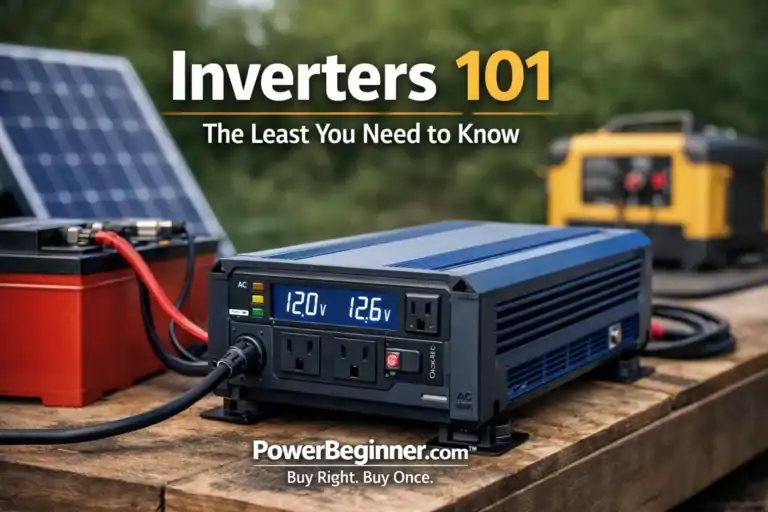
Calculate Running Loads
List everything you might run simultaneously and add up the wattages:
- Refrigerator: 150W
- Laptop: 60W
- LED lights: 50W
- Phone charging: 20W
- Fan: 50W
- Total running: 330W
Account for Surge Loads
Motors and compressors surge at startup. The refrigerator compressor might draw 600W starting even though it runs at 150W. You need an inverter that handles this surge while running other loads.
Total with surge: 330W – 150W + 600W = 780W peak
Add Safety Margin
Never run inverters at 100% capacity continuously. Aim for 70-80% of rated capacity for normal operation:
780W ÷ 0.75 = 1,040W minimum inverter size
A 1500W pure sine wave inverter handles this scenario comfortably.
Avoid Massive Oversizing
A 5000W inverter for 500W of loads wastes money and energy. Inverters consume power just running their own electronics—larger inverters consume more. Match the inverter to your realistic maximum needs.
Efficiency and Power Consumption
Inverter Efficiency
No inverter is 100% efficient. Typical efficiencies range from 85-95%, meaning 5-15% of battery power becomes waste heat rather than usable AC power.
Higher efficiency means:
- Longer battery runtime
- Less heat generation
- Lower operating cost
Quality pure sine wave inverters typically achieve 90-95% efficiency at moderate loads. Efficiency drops at very light loads (inverter overhead becomes proportionally larger) and very heavy loads (more heat generation).
No-Load Power Draw
Inverters consume power even with nothing plugged in. This “standby” or “no-load” draw might be 5-25W depending on inverter size and design.
For intermittent use, this doesnt matter much. For systems that run inverters continuously, no-load draw adds up. A 20W no-load draw consumes 480Wh daily—a meaningful portion of a small battery bank.
Some inverters include “search mode” or “eco mode” that reduces standby consumption when no loads are detected, then powers up instantly when loads appear.
Input Voltage Requirements
Matching System Voltage
Inverters are designed for specific DC input voltages:
- 12V inverters: Most common for RVs, vehicles, and small systems
- 24V inverters: More efficient for medium systems
- 48V inverters: Standard for larger residential solar systems
The inverter voltage must match your battery bank voltage exactly. A 12V inverter on 24V batteries will be destroyed instantly. A 24V inverter on 12V batteries wont function at all.
Voltage Range Tolerance
Battery voltage varies with charge state. A “12V” system might range from 10.5V (nearly dead) to 14.4V (charging). Inverters specify acceptable input ranges—typically 10.5-15V for 12V models.
Operating outside the specified range triggers low-voltage shutdown (protecting batteries from over-discharge) or high-voltage shutdown (protecting electronics from overvoltage during charging).
Installation Considerations
Cable Sizing
Inverters draw high DC current. A 2000W inverter at 12V draws over 180 amps at full load. This requires very heavy cables—undersized cables cause voltage drop, heat, and potential fire.
Short cable runs reduce losses. Mount inverters as close to batteries as practical, using manufacturer-recommended cable sizes.
Fusing
All inverter installations require appropriate fusing between batteries and inverter. A short circuit in unfused high-current DC wiring can cause fires. Size fuses according to cable capacity and inverter specifications.
Ventilation
Inverters generate heat, especially under heavy load. Adequate ventilation prevents overheating and shutdown. Never enclose inverters in unventilated spaces.
Grounding
Proper grounding protects against electrical faults. Follow manufacturer instructions and local electrical codes. For fixed installations, consider professional installation.
Inverter/Chargers
Combined Function Units
Inverter/chargers combine an inverter with a battery charger in one unit. When shore power or generator power is available, they charge the batteries. When external power is unavailable, they invert battery power to AC.
Benefits include:
- Single unit instead of separate inverter and charger
- Automatic switching between modes
- Often includes transfer switch function
- Simplified wiring
These units are standard for RVs and off-grid systems where both functions are needed.
Transfer Switching
Quality inverter/chargers include automatic transfer switching. When shore power connects, the unit switches from inverter mode to charger mode seamlessly. When shore power disconnects, it switches back to inverter mode automatically.
Transfer time matters for sensitive electronics. Fast transfer times (under 20 milliseconds) prevent computer restarts and clock resets. Slower transfer times may cause brief interruptions.
Advanced Features
Remote Monitoring
Many modern inverters include remote panels or app connectivity for monitoring and control. Check power usage, battery status, and adjust settings without accessing the inverter directly.
Programmable Settings
Configurable charging parameters, transfer voltages, and operating modes let you optimize for your specific system and usage patterns.
Stacking and Parallel Operation
Some inverters can be paralleled for increased capacity or stacked for 240V output. This allows system expansion without replacing the original inverter.
Generator Support
Inverter/chargers designed for generator charging include features that optimize generator runtime—bulk charging quickly, then shutting down the generator when batteries reach a programmed level.
Common Applications
RV and Camper
RV inverters power entertainment systems, small appliances, and charging during dry camping. Typical sizes range from 1000W for basic needs to 3000W+ for air conditioning and microwaves. Inverter/chargers are standard for built-in systems.
Marine
Similar to RV applications with added requirements for marine-grade components and protection from corrosion and moisture. Marine-specific inverters include appropriate certifications.
Off-Grid Solar
Solar systems pair inverters with charge controllers and battery banks for complete off-grid power. Sizing depends on household loads—small cabins might use 2000W inverters while full off-grid homes need 5000W+.
Backup Power
Grid-tied homes increasingly add battery backup with inverters to maintain power during outages. These systems range from small backup for essentials to whole-house systems that operate indefinitely off-grid.
Vehicle Power
Small inverters (150-400W) plug into vehicle 12V outlets for laptop charging and small device power. Larger installations with dedicated wiring support power tools and mobile offices.
Inverters vs. Power Stations
Portable power stations include batteries, inverter, and charge controller in one integrated unit. They’re convenient but less flexible and expandable than component systems.
Choose a power station when:
- Portability matters most
- You want plug-and-play simplicity
- Capacity needs are fixed and modest
- You dont want to design a system
Choose separate inverter and batteries when:
- You need larger capacity
- Future expansion is likely
- You want component flexibility
- Budget allows for better long-term value
Common Mistakes to Avoid
Buying modified sine wave to save money. The savings vanish when you damage electronics or listen to motors buzz. Pure sine wave prices have dropped—its worth the modest premium.
Ignoring continuous ratings. That 3000W inverter might only sustain 1500W. Read specifications carefully and size for continuous needs.
Undersizing for surge loads. Your refrigerator runs at 150W but starts at 600W. If the inverter cant handle the surge, the compressor wont start.
Massive oversizing. A 5000W inverter for 500W loads wastes money on purchase and wastes energy on standby consumption. Right-size your inverter.
Inadequate cables. High-current DC wiring requires heavy cables. Voltage drop from undersized cables causes problems ranging from reduced performance to fires.
Poor ventilation. Inverters generate heat. Enclosed installation without airflow causes overheating and shutdown—or worse.
Ignoring the manual. Installation requirements, limitations, and warranty conditions are documented. Read before installing.
Frequently Asked Questions
What size inverter do I need?
Add up your simultaneous running loads, account for surge requirements, and add 25-30% margin. A household running 500W of typical loads with a refrigerator (600W surge) needs at least 1100W continuous capacity—a 1500W or 2000W inverter provides comfortable margin.
Can I run my microwave on an inverter?
Yes, with adequate sizing. Microwaves draw 800-1500W depending on size. The inverter must provide this continuously, plus margin for other loads. A 1000W microwave needs at least a 1500W inverter with nothing else running, or larger for simultaneous use with other devices.
Will a modified sine wave inverter damage my electronics?
Potentially. Sensitive electronics, motors, and devices with timing circuits may malfunction or sustain damage. Pure sine wave is safe for everything. Use modified sine wave only for basic resistive loads like incandescent lights and simple heating elements.
How do I connect an inverter to my battery?
Use appropriately sized cables—heavier than you think necessary due to high DC current. Install a fuse at the battery within 18 inches of the positive terminal. Follow manufacturer instructions for your specific inverter. When in doubt, hire a professional.
Can I run my inverter while driving?
Yes, vehicle alternators can power inverters during travel. However, most vehicle electrical systems support only small inverters (400W or less) from the standard 12V outlet. Larger inverters require dedicated wiring from the battery with appropriate fusing.
Why does my inverter shut down under load?
Common causes include: battery voltage dropping below minimum threshold (batteries too small or too discharged), overheating from inadequate ventilation, or attempting to run loads exceeding the inverter’s capacity. Check all three.
Do I need an inverter if I have solar panels?
Yes, for AC loads. Solar panels produce DC power. Batteries store DC power. To run standard AC appliances, you need an inverter to convert DC to AC. The only exception is systems running exclusively on DC devices like 12V lighting and DC refrigerators.
Last updated: February 2026. Technology evolves—verify current specifications before purchasing.