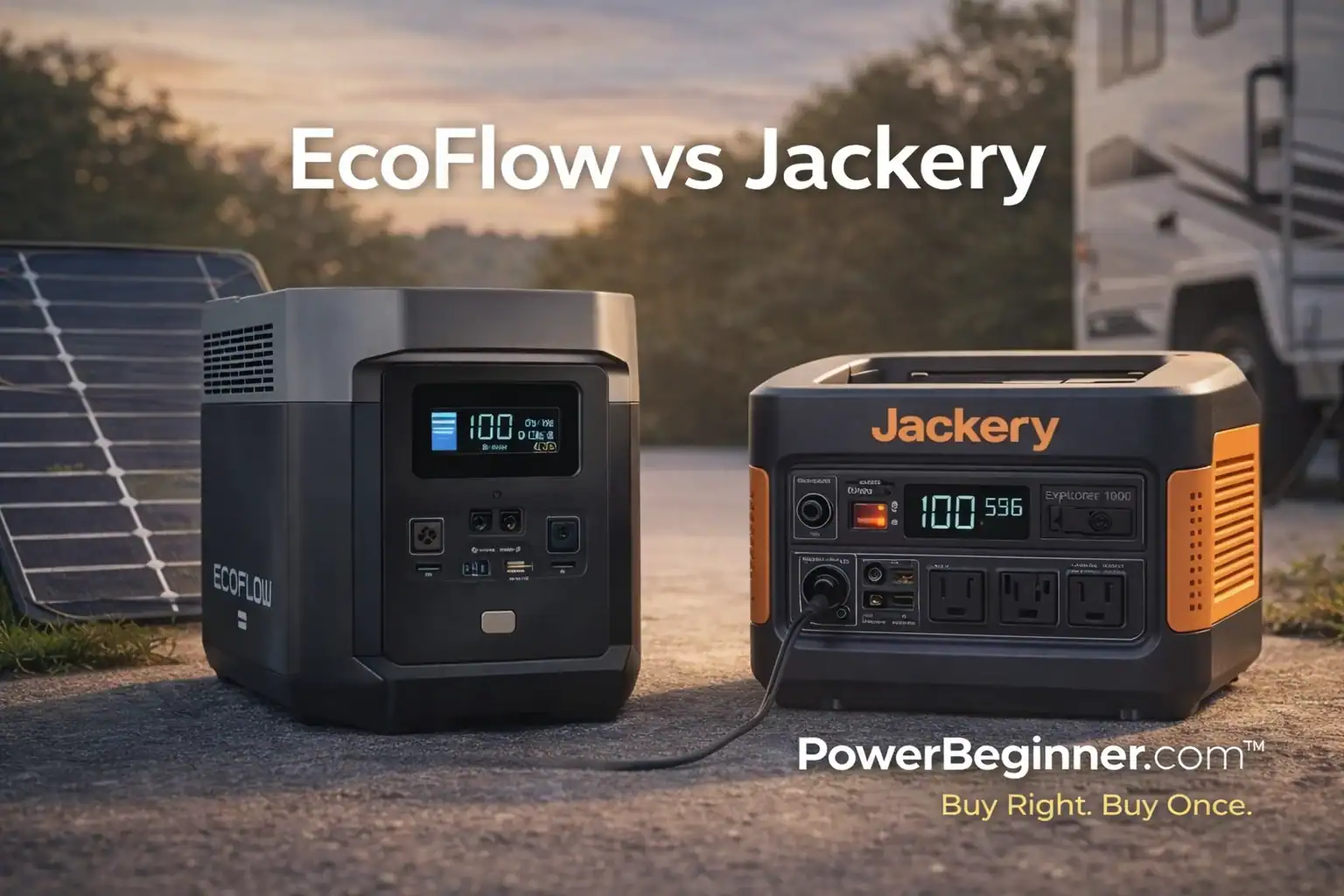
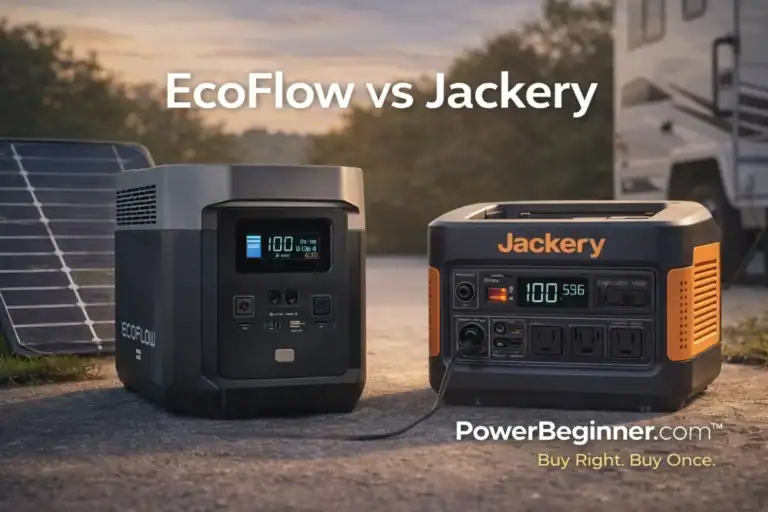
Jackery invented the consumer portable power station category. EcoFlow entered later with aggressive innovation and competitive pricing. Both now dominate a market they largely created.
Choosing between them isnt about one being objectively better—its about which strengths matter more for your specific needs. Jackery offers refined simplicity and proven reliability. EcoFlow offers faster charging and more features. Both produce excellent products.
This comparison breaks down the real differences to help you make the right choice.
Brand Philosophies
Understanding each company’s approach explains their product differences.
Jackery: Pioneer Refinement
Jackery created this market and has spent years refining their approach. Their products emphasize simplicity, reliability, and user experience polish. They dont rush features to market—they wait until implementation is solid.
The result is products that feel refined but may lack cutting-edge features. Jackery prioritizes things working correctly over being first with new capabilities.
EcoFlow: Aggressive Innovation
EcoFlow entered later with something to prove. They compete through faster charging speeds, more features, and competitive pricing. Their product development cycle moves quickly, releasing updates and new models regularly.
The result is products with impressive specifications and features but occasionally less polish. EcoFlow prioritizes capability advancement over refinement.
Head-to-Head Comparison
Charging Speed
EcoFlow wins decisively. Their X-Stream charging technology delivers 0-80% in approximately 50 minutes via wall outlet. Jackery takes about 1.8 hours to reach the same level.
This matters when storms approach and you need to top off quickly, or when you’re packing for a trip with limited preparation time. EcoFlow’s charging advantage is significant and consistent across their lineup.
Real-world impact: EcoFlow charges roughly 2x faster than Jackery via wall outlet.
Battery Chemistry
Tie. Both brands have transitioned to LiFePO4 (lithium iron phosphate) batteries in their current lineups. LiFePO4 provides 3,000+ charge cycles compared to 500-800 cycles for older lithium-ion chemistry.
Earlier Jackery models used lithium-ion, so check specifications on older/discounted units. Current models from both brands use similar battery chemistry with similar longevity expectations.
Real-world impact: Both brands now offer comparable battery lifespan.
Build Quality and Reliability
Jackery has the edge based on longer market presence and more accumulated reliability data. They’ve had more years to identify and fix issues, and more customer units have proven themselves over time.
EcoFlow products appear well-built, and early reliability reports are positive. But Jackery simply has more real-world hours logged across more units.
Real-world impact: Jackery’s longer track record provides more certainty.
Product Ecosystem
EcoFlow offers more flexibility. Expandable battery options on some models let you add capacity later. Their lineup includes more specialized products for different use cases.
Jackery provides a focused, curated lineup that covers mainstream needs without overwhelming options. Their solar panel integration is excellent but less extensive than EcoFlow’s ecosystem.
Real-world impact: EcoFlow suits buyers who want expandability; Jackery suits those who prefer simplicity.
Pricing
EcoFlow typically prices more aggressively. Their comparable models often cost slightly less than Jackery equivalents, and they run frequent promotions.
Jackery pricing remains stable and occasionally seems premium compared to competitors. The brand name carries some price premium.
Real-world impact: Budget-focused buyers may find better deals with EcoFlow.
Customer Support
Comparable. Both companies maintain support infrastructure for their products. Response times and resolution quality appear similar based on customer reports. Neither is dramatically better or worse.
Real-world impact: No significant advantage either direction.
Product Comparisons: 1000Wh Class
This is where most buyers should focus—the sweet spot of capacity, portability, and price.
Jackery Explorer 1000 v2
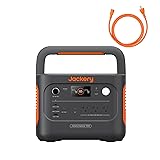
- Powerful & Compact: 1,500W AC output with 3,000W surge peak powers appliances like AC units, fridges, and electric pots. With a 1,070Wh capacity, lightweight design (23.8 lbs), and foldable handle, it's ideal for camping, road trips, or emergencies.
- Ultra-Fast Charging (1 Hour): Fully charge from 0% to 100% in just one hour using emergency mode activated through the Jackery App. Default 1.7-hour charge optimizes battery lifespan. Equipped with advanced ChargeShield 2.0 technology for safer, smarter charging.
- Long-lasting Battery Life: Durable LFP battery retains over 70% capacity after 4,000 charge cycles, providing a lifespan of over 10 years.
- Versatile Power Options: Includes 3 pure sine wave AC outlets, 2 USB-C ports (PD 100W), 1 USB-A port, 1 DC car port, and LED lights, allowing simultaneous device charging for multiple scenarios without additional adapters.
- Smart App Control: Easily manage charging modes via the Jackery App—choose between rapid emergency charging, quiet overnight charging (30 dB), or energy-saving modes tailored to your specific needs.
- 1,070 Wh capacity
- 1,500W output (2,200W surge)
- 1.8 hours to 80% charge
- LiFePO4 battery, 3,000+ cycles
- 4.7 stars from 4,400+ reviews
The Explorer 1000 v2 represents Jackery’s mainstream flagship. The LiFePO4 battery provides decade-long durability. The refined interface reflects years of customer feedback. This is the power station most Jackery buyers should consider first.
EcoFlow DELTA 2

- Clean, Green Charging. With up to 500W of solar panel input, DELTA 2 is a solar generator that can be charged while camping, on an RV trip or off-grid. Includes a 220W Bifacial solar panel to capture up to 25% more energy.
- Built to Last 6x Longer. Its LFP battery chemistry makes for a portable power station with a 3000+ cycle life. Enough for years on end of use. With a sophisticated BMS, you can go easy knowing its an auto-regulating portable battery to keep you safe.
- Power Almost Anything. Solar powered generator have come a long way. Power all your appliances with 1800W output, that's on par with outdoor generators without the fumes or noise. With 15 outlets and its huge output, you can power 90% of your appliances.
- Expandable Capacity from 1-3kWh. With the standalone portable power station sporting 1kWh, you can add on extra batteries to reach up to 3kWh. Ideal for camping, RVs or home backup power.
- What you Get. DELTA 2 Power station, 220W Solar panel, Adjustable kickstand case, AC charging cable, Solar charging cable, User manual, and an exclusive 5 customer service.

- 1,024 Wh capacity
- 1,800W output (2,700W surge)
- 50 minutes to 80% charge
- LiFePO4 battery, 3,000+ cycles
- 4.7 stars from 7,500+ reviews
The DELTA 2 showcases EcoFlow’s charging speed advantage. The higher output handles more demanding loads. Expandable to 3kWh with additional batteries. For buyers who prioritize fast charging and expandability, this is the clear choice.
Winner: EcoFlow for faster charging and higher output. Jackery for proven refinement. Both excellent choices.
Product Comparisons: 2000Wh Class
For extended backup and serious capacity needs.
Jackery Explorer 2000 v2

- Powerful and Versatile: Designed to meet power demands for home backup, camping trips, and small businesses, the Jackery Solar Generator 2000 v2 has 3 AC ports with a powerful 2200W output and an impressive 2040Wh capacity. Plus, the USB-C PD 100W port activates efficient, lightning-fast charging for your electronic devices - no extra adapters are required
- Smallest & Lightest 2kWh Power: The Jackery Solar Generator 2000 v2, weighing in at 39.5 lbs, is 41% lighter and 34% smaller than conventional 2kWh LiFePo4 portable power stations. Enhanced by CTB (Cell-to-Body) technology, used by electric vehicles, it maximizes space efficiency and offers a compact, more secure structure with superior stability and safety.
- Flexible & Efficient Charging: Power up the Solar Generator 2000 v2 to 80% in just 66 minutes with AC Charging, or achieve a full charge in 102minutes with the app-activated Emergency Super Charging mode. Solar charging takes 6 hours with 400W panels, while Silent Charging mode provides a full charge in 5 hours at just 30dB, allowing you to work or sleep without disruption.
- Enhanced Durability & Safety. The Jackery Solar Generator 2000 v2 comes with an advanced temperature control system that minimizes fan noise for a quieter operation. Its durable LiFePo4 battery provides up to 10 years of performance, making it ideal for indoor use. It runs silently and produces no fumes, offering a clean, safe, and eco-friendly alternative to gas generators.
- Uninterrupted Power Supply: Featuring 20ms seamless switching, this portable power station is built to handle unexpected power disruptions, keeping your power ON during energy outages from grid issues to natural disasters like hurricanes and storms. UL1778 test certified for Uninterruptible Power Systems, it guarantees reliable backup power and protects your critical devices inside or outside your home.
- 2,042 Wh capacity
- 2,200W output (4,400W surge)
- DC-DC alternator charging option
- LiFePO4 battery
- 4.7 stars from 866+ reviews
When 1,000 Wh isnt enough, the Explorer 2000 v2 doubles the capacity. This handles extended outages, larger appliances, and power-hungry devices. The DC-DC charging option lets you recharge while driving—useful for road trips.
EcoFlow DELTA 2 Comparison
EcoFlow offers the DELTA 2 Max in this capacity class with similar specifications and their signature fast charging. Both brands deliver comparable performance at this tier—choose based on brand preference and specific feature priorities.
Winner: Tie at this capacity level. Both brands deliver excellent 2kWh options.
Use Case Recommendations
For Camping and Recreation
Recommendation: Jackery
The refined user experience and proven reliability matter when you’re away from home and need equipment that works. Charging speed matters less when you can plan ahead.
For Emergency Home Backup
Recommendation: EcoFlow
The faster charging speed becomes critical when storms approach and you need to maximize capacity quickly. The higher output also handles more demanding loads.
For RV Living
Recommendation: EcoFlow
Expandability matters for RV owners who may want to grow their system over time. The higher output handles RV appliances better.
For Occasional Use
Recommendation: Jackery
When the power station sits unused for months between needs, proven long-term reliability matters more than cutting-edge features.
For Tech Enthusiasts
Recommendation: EcoFlow
More features, expandability options, and frequent product updates appeal to buyers who enjoy having the latest capabilities.
For Simplicity Seekers
Recommendation: Jackery
A focused lineup with refined products suits buyers who want something that works without complexity or overwhelming options.
Common Questions
Which brand is more reliable?
Jackery has more years of proven reliability data simply from market presence. EcoFlow appears reliable but has less long-term track record. For risk-averse buyers, Jackery provides more certainty.
Which charges faster?
EcoFlow, significantly. Their X-Stream technology charges roughly 2x faster than comparable Jackery models via wall outlet. This is EcoFlow’s clearest advantage.
Which has better value?
EcoFlow typically prices slightly lower and runs more frequent promotions. For pure price-to-specification ratio, EcoFlow often wins. Jackery’s higher prices reflect brand premium and proven track record.
Which is better for solar charging?
Comparable. Both accept similar solar input and pair with dedicated panels. Jackery’s solar ecosystem is more curated; EcoFlow’s is more extensive. Neither has clear advantage.
Can I expand capacity later?
EcoFlow offers expansion batteries on select models. Jackery provides limited expansion options. If future capacity growth matters, EcoFlow provides more flexibility.
Which has better app experience?
Both offer functional apps for monitoring and control. Neither is dramatically better. EcoFlow’s app offers slightly more features; Jackery’s is slightly simpler.
Frequently Asked Questions
Is Jackery worth the higher price?
For buyers who value proven reliability and refined user experience over cutting-edge features, yes. Jackery’s premium reflects years of refinement and accumulated trust. Budget-focused buyers may prefer EcoFlow’s value proposition.
Is EcoFlow reliable?
Early indications are positive with strong reviews and few widespread issues reported. However, the brand has less long-term track record than Jackery. For most buyers, EcoFlow reliability appears adequate.
Can I use third-party solar panels with either brand?
Yes, both accept standard MC4 solar connections within their voltage and wattage specifications. Brand-specific panels ensure compatibility but aren’t required.
Which brand has better customer service?
Reports are similar for both—adequate response times and reasonable issue resolution. Neither is dramatically better or worse. Both maintain support infrastructure appropriate to their market position.
Should I wait for newer models?
Both brands update products regularly. If current models meet your needs, buy now. Waiting for next-generation products means waiting forever as both companies continuously innovate.
Do these brands make generators too?
No. Both Jackery and EcoFlow focus exclusively on battery-based power stations. For combustion generators, look to Westinghouse, WEN, Champion, Honda, and similar brands.
Which is better for apartment dwellers?
Either works perfectly. Both are silent, emission-free, and safe for indoor use. Choose based on capacity needs and budget rather than apartment-specific factors.
Last updated: February 2026. Prices and availability subject to change. We may earn a commission from purchases made through links on this page.
Last update on 2026-03-02 / Affiliate links / Images from Amazon Product Advertising API