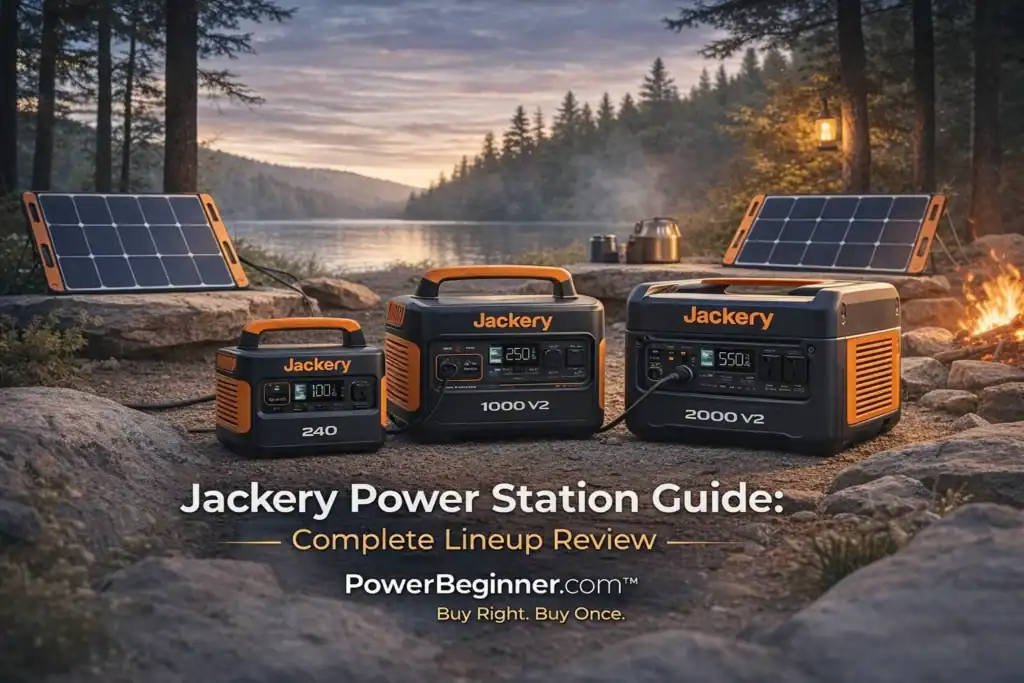
The brand that invented portable power stations. Heres what makes them worth considering.
Before Jackery, backup power meant gasoline generators with their noise, fumes, and outdoor-only operation. Jackery saw a different market—people who wanted power they could use anywhere, including indoors, without the hassle of combustion engines.
The company essentially invented the consumer portable power station. They weren’t first to put batteries in a box, but they were first to make it practical, affordable, and accessible to regular buyers. That head start gave them years to refine their products while competitors scrambled to catch up.
Today, Jackery faces serious competition from EcoFlow, Anker, and others. But their experience shows in product refinement, customer support infrastructure, and the kind of reliability data that only comes from millions of units in real-world use.
Why Jackery Stands Out
Several factors distinguish Jackery from the crowded power station market.
LiFePO4 battery chemistry across the modern lineup. Lithium iron phosphate batteries last 3,000+ charge cycles compared to 500-800 cycles for older lithium-ion chemistry. This translates to roughly 10 years of daily use before significant capacity degradation.
Refined user experience from years of iteration. The interface, displays, and controls reflect feedback from millions of customers. Small details like handle placement, port arrangement, and display readability benefit from this real-world refinement.
Established support infrastructure. Jackery maintains customer service, warranty support, and parts availability that newer competitors havent yet built. When you need help, you can actually reach someone.
Solar ecosystem integration. Jackery sells matched solar panels designed to work optimally with their power stations. You can buy from other brands, but the integrated ecosystem simplifies setup and ensures compatibility.
Jackery Explorer Lineup
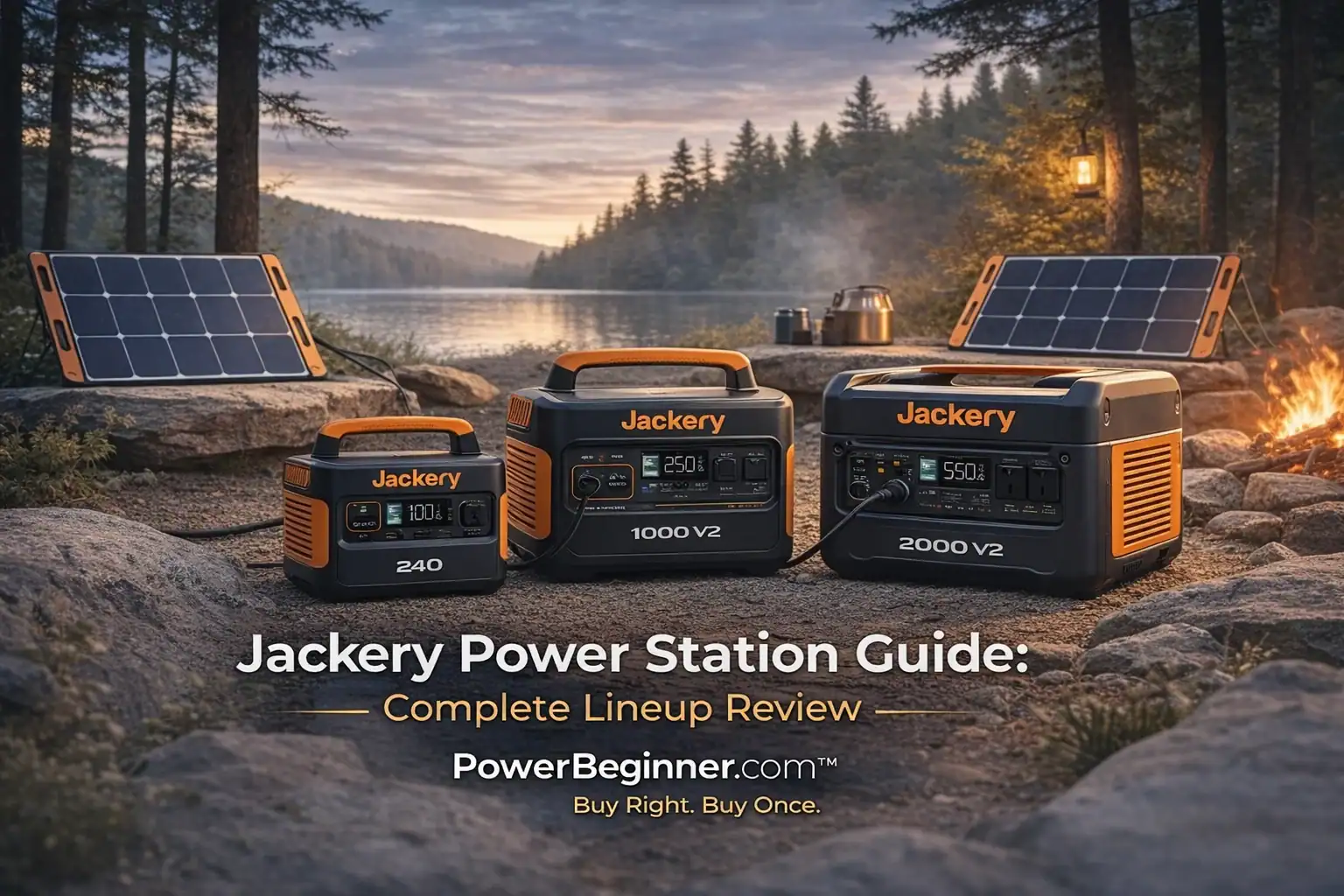
Jackery Explorer 1000 v2
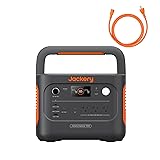
- Powerful & Compact: 1,500W AC output with 3,000W surge peak powers appliances like AC units, fridges, and electric pots. With a 1,070Wh capacity, lightweight design (23.8 lbs), and foldable handle, it's ideal for camping, road trips, or emergencies.
- Ultra-Fast Charging (1 Hour): Fully charge from 0% to 100% in just one hour using emergency mode activated through the Jackery App. Default 1.7-hour charge optimizes battery lifespan. Equipped with advanced ChargeShield 2.0 technology for safer, smarter charging.
- Long-lasting Battery Life: Durable LFP battery retains over 70% capacity after 4,000 charge cycles, providing a lifespan of over 10 years.
- Versatile Power Options: Includes 3 pure sine wave AC outlets, 2 USB-C ports (PD 100W), 1 USB-A port, 1 DC car port, and LED lights, allowing simultaneous device charging for multiple scenarios without additional adapters.
- Smart App Control: Easily manage charging modes via the Jackery App—choose between rapid emergency charging, quiet overnight charging (30 dB), or energy-saving modes tailored to your specific needs.
The Explorer 1000 v2 represents Jackery’s mainstream flagship—the model most buyers should consider first. At 1,070 Wh capacity and 1,500W output (2,200W surge), it handles most portable power needs while remaining genuinely portable.
The LiFePO4 battery provides 3,000+ charge cycles of longevity. Fast charging reaches 0-80% in about 1.8 hours via wall outlet. Solar input supports up to 200W for off-grid charging.
This is the power station that keeps your refrigerator running during short outages, charges all your devices during camping trips, and powers essential equipment when you need it. The capacity hits the sweet spot—enough for real utility without excessive weight or cost.
Over 4,400 reviews at 4.7 stars from owners who’ve tested this station through countless real-world scenarios.
Jackery Explorer 2000 v2

- Powerful and Versatile: Designed to meet power demands for home backup, camping trips, and small businesses, the Jackery Solar Generator 2000 v2 has 3 AC ports with a powerful 2200W output and an impressive 2040Wh capacity. Plus, the USB-C PD 100W port activates efficient, lightning-fast charging for your electronic devices - no extra adapters are required
- Smallest & Lightest 2kWh Power: The Jackery Solar Generator 2000 v2, weighing in at 39.5 lbs, is 41% lighter and 34% smaller than conventional 2kWh LiFePo4 portable power stations. Enhanced by CTB (Cell-to-Body) technology, used by electric vehicles, it maximizes space efficiency and offers a compact, more secure structure with superior stability and safety.
- Flexible & Efficient Charging: Power up the Solar Generator 2000 v2 to 80% in just 66 minutes with AC Charging, or achieve a full charge in 102minutes with the app-activated Emergency Super Charging mode. Solar charging takes 6 hours with 400W panels, while Silent Charging mode provides a full charge in 5 hours at just 30dB, allowing you to work or sleep without disruption.
- Enhanced Durability & Safety. The Jackery Solar Generator 2000 v2 comes with an advanced temperature control system that minimizes fan noise for a quieter operation. Its durable LiFePo4 battery provides up to 10 years of performance, making it ideal for indoor use. It runs silently and produces no fumes, offering a clean, safe, and eco-friendly alternative to gas generators.
- Uninterrupted Power Supply: Featuring 20ms seamless switching, this portable power station is built to handle unexpected power disruptions, keeping your power ON during energy outages from grid issues to natural disasters like hurricanes and storms. UL1778 test certified for Uninterruptible Power Systems, it guarantees reliable backup power and protects your critical devices inside or outside your home.
When 1,000 Wh isnt enough, the Explorer 2000 v2 doubles the capacity to 2,042 Wh with 2,200W output (4,400W surge). This handles extended outages, larger appliances, and power-hungry devices that smaller stations cant manage.
The increased capacity powers a refrigerator for 16-18 hours rather than 8-10. It runs more demanding equipment like portable air conditioners and power tools. For RV owners, it provides genuine multi-day capability between charges.
The DC-DC alternator charging option lets you recharge while driving—useful for road trips where wall outlets are scarce. Solar input handles up to 500W for faster off-grid charging.
866 reviews at 4.7 stars from owners who needed serious capacity and found it here.
Jackery Explorer 240

- Easy to Carry: This entry level portable power station is equipped with an excellent 240Wh lithium-ion battery pack, weighing a feather-light, 6.6 pounds. The solid handle, additionally makes for easier carrying, for awesome outdoor adventures - tent camping, road trips, backyard camping, garden relaxation, and more. Experience on the go and fully convenient charging, anywhere and any time with friends and family alike.
- Versatile Power Source: The Explorer 240 is extremely versatile, featuring 1 pure sine wave AC outlet (110V 200W 400W Peak), 2 USB-A ports (5V, 2.4A), and 1 12V DC car port, charging all necessary road trip essentials, including smart phones, laptops, cameras and fans. Pass-through charging is supported, allowing flexible, convenient and worry free charging, on your exploration and travels.
- Green Power Supply: The power station can be recharged by either the Jackery SolarSaga 60 Solar Panel or SolarSaga 100 Solar Panel. Its built-in MPPT controller further enables the solar panel to operate at its maximum power point, allowing for exceptionally efficient and quick recharging. Green, convenient and efficient charging is here.
- Two Alternative Recharging Methods: Two further charging methods are also available, with the power station. Charging via wall or car outlet are two other options, to solar charging, allowing greater freedom, when charging. Adventure to all your favourite destinations and places, the world has to offer, with Jackery's Explorer 240.
- What's Included: 1 * Jackery Explorer 240 Portable Power Station, 1 * AC Adapter, 1 * Car Charger Cable, 1 * User Guide.
The entry point to Jackery’s lineup provides 240 Wh capacity for the most basic needs. This charges phones and tablets, runs small devices, and provides emergency lighting during short outages.
At around $199, the Explorer 240 costs less than many competitors’ larger units. For buyers who want to try portable power without significant investment, this model provides genuine utility at minimal cost.
The limited capacity restricts applications, but for phone charging, laptop power, and similar light loads, 240 Wh provides multiple days of capability. The compact size and 6.6-pound weight make it truly portable—you’ll actually carry it rather than leaving it in your vehicle.
Strong review history across years of market presence from buyers who needed simple, affordable backup power.
Solar Panel Options
Jackery sells matched solar panels designed for their power stations. While third-party panels work, the integrated ecosystem simplifies setup.
SolarSaga 100W – The mainstream panel for most users. Pairs well with Explorer 240 and 1000 models. Two panels can work in parallel for faster charging.
SolarSaga 200W – Higher output for faster charging. Single panel charges Explorer 1000 v2 in 5-6 hours of good sunlight.
SolarSaga 80W – Compact option for ultralight camping and smaller stations.
Realistic expectations for solar charging: A 200W panel produces 200W only under perfect conditions. Real-world output typically runs 60-80% of rated capacity. Plan charging times accordingly and consider panels as supplementary rather than primary charging sources.
Jackery vs EcoFlow
The two dominant power station brands take different approaches.
Jackery strengths:
- Longer market presence with more refined products
- Established support infrastructure
- Strong track record for reliability
- Clean, simple user interface
EcoFlow strengths:
- Faster charging speeds (50 minutes to 80%)
- More aggressive pricing on comparable capacity
- Expandable battery options on some models
- More frequent product updates
Bottom line: Both brands produce quality products. Jackery offers proven reliability from a longer track record. EcoFlow offers faster charging and sometimes better pricing. Neither choice is wrong for most buyers.
Jackery vs Anker
Anker entered the power station market more recently but brings significant electronics expertise.
Jackery advantages:
- More extensive product lineup
- Longer track record specifically in power stations
- More real-world reliability data
Anker advantages:
- Excellent customer support infrastructure (from their broader electronics business)
- Competitive pricing
- Strong build quality from electronics heritage
Bottom line: Anker is a legitimate competitor with excellent support. Jackery has more specialized experience. Both produce reliable products.
Choosing the Right Jackery Model
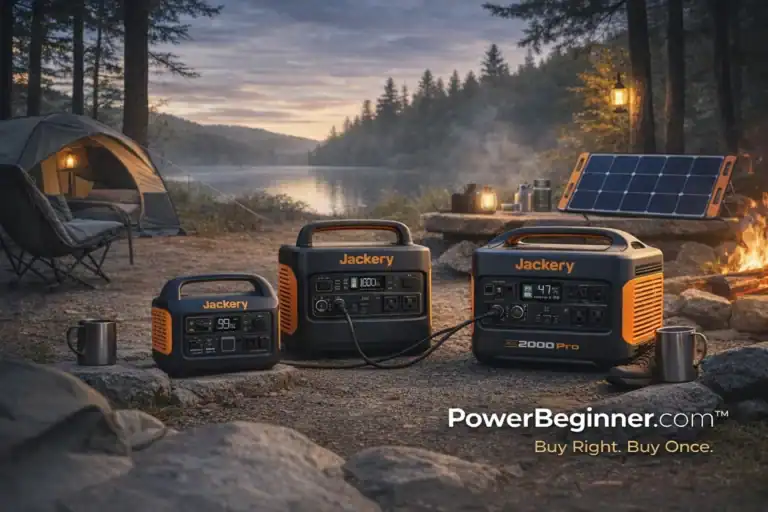
For basic device charging and light use: Explorer 240. Enough for phones, tablets, laptops, and small devices without paying for unused capacity. Perfect for testing whether a power station fits your needs.
For most buyers: Explorer 1000 v2. The sweet spot of capacity, portability, and price for camping, emergency backup, and general portable power needs. This is where most buyers should start.
For extended backup or RV use: Explorer 2000 v2. Double the capacity for double the runtime on essential loads. The DC-DC alternator charging adds flexibility for road trips.
Runtime Expectations
Actual runtime depends on your specific loads. Here are realistic estimates:
Explorer 240 (240 Wh):
- Phone charging (20W): ~10 charges
- Laptop (60W): ~3.5 hours
- LED lights (10W): ~20 hours
- Small fan (20W): ~10 hours
Explorer 1000 v2 (1,070 Wh):
- Phone charging (20W): ~45 charges
- Laptop (60W): ~15 hours
- CPAP (30W): 2-3 nights
- Mini fridge (50W): ~18 hours
- Full-size refrigerator (100W avg): ~9 hours
Explorer 2000 v2 (2,042 Wh):
- Phone charging: ~85 charges
- Laptop: ~28 hours
- CPAP: 4-5 nights
- Mini fridge: ~34 hours
- Full-size refrigerator: ~17 hours
These estimates assume full charge and stated power consumption. Real loads vary, and efficiency losses reduce usable capacity by approximately 10-15%.
When to Choose Jackery Over Generators
Power stations and generators serve different needs. Jackery makes sense when:
Silence matters. Power stations produce zero noise. For camping, apartment living, or anywhere noise is a concern, this is decisive.
Indoor use is required. Power stations are completely safe indoors—no emissions, no carbon monoxide risk. Generators must stay outside.
Portability is paramount. The Explorer 240 weighs 6.6 pounds. The 1000 v2 weighs 24 pounds. Comparable generators weigh 40-50+ pounds.
Simplicity is valued. No fuel, no oil changes, no carburetor maintenance, no starting issues. Charge it, use it, done.
Generators make more sense when:
- You need sustained high power (central AC, well pumps)
- Extended runtime matters more than convenience
- Unlimited fuel availability beats battery capacity
Many buyers own both—a power station for convenience and light loads, a generator for serious backup power.
Frequently Asked Questions
How long do Jackery power stations last?
LiFePO4 models are rated for 3,000+ charge cycles before reaching 80% original capacity. With daily cycling, thats roughly 8-10 years. The Explorer 240 uses older lithium-ion chemistry with 500-800 cycle lifespan. The LiFePO4 upgrade in newer models significantly extended expected lifespan.
Can a Jackery power station run a refrigerator?
Yes. The Explorer 1000 v2 and larger models can run standard refrigerators for 8-18 hours depending on model size and station capacity. Refrigerators cycle on and off rather than running continuously, so actual runtime often exceeds simple calculations.
Is Jackery still the best power station brand?
Jackery remains excellent but no longer dominates unchallenged. EcoFlow and Anker offer competitive products with different strengths. Jackery’s advantages are proven reliability and refined user experience from years of iteration.
Can I charge a Jackery while using it?
Yes, this is called pass-through charging. Most Jackery models support it, though some limit output during simultaneous charging. Check your specific model’s specifications.
How long does it take to charge a Jackery via solar?
With appropriately sized panels in good sunlight: Explorer 240 takes 5-6 hours with 100W panel, Explorer 1000 v2 takes 5-6 hours with 200W panel, Explorer 2000 v2 takes similar time with larger panel arrays. Cloudy conditions significantly extend charging times.
Are Jackery power stations safe for indoor use?
Yes. Unlike gas generators, power stations produce no emissions and are completely safe for indoor use including bedrooms. This is their primary advantage over combustion generators.
Should I buy Jackery solar panels or third-party panels?
Jackery panels are optimized for their stations and simplify setup. Third-party panels can work but require matching specifications carefully. For most users, the integrated ecosystem justifies the Jackery panel premium.
Last updated: February 2026. Prices and availability subject to change. We may earn a commission from purchases made through links on this page.
Last update on 2026-03-02 / Affiliate links / Images from Amazon Product Advertising API