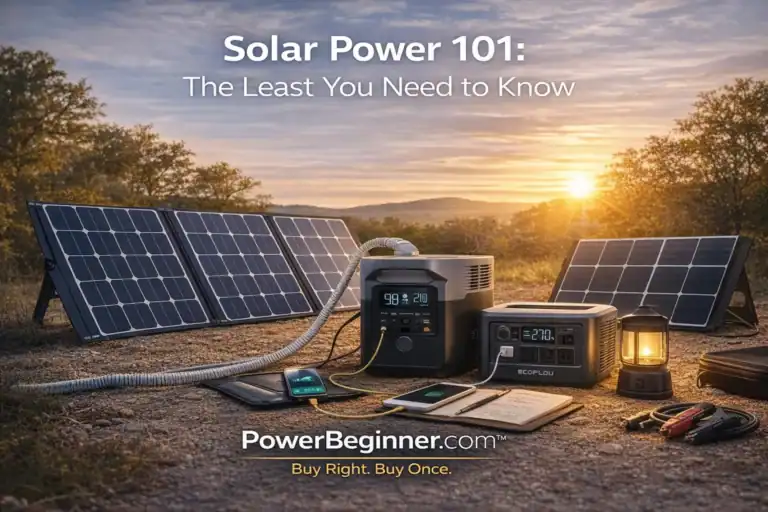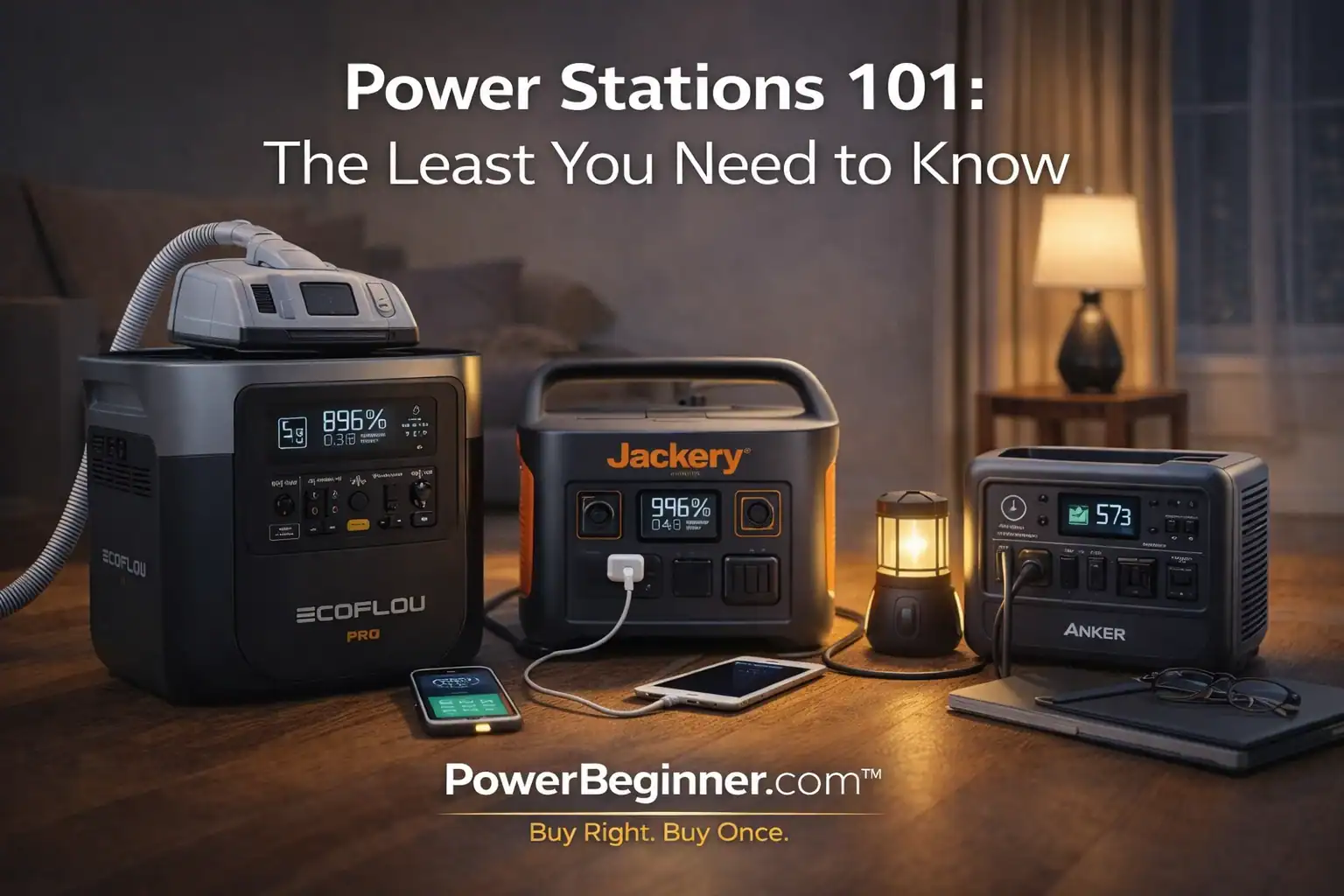
Portable power stations are essentially large rechargeable batteries with built-in outlets. No engine, no fuel, no exhaust. Charge them before an outage, then use that stored electricity when you need it. Simple concept, genuinely useful technology.
The Least You Need to Know
If you read nothing else, understand these fundamentals.
Power stations store electricity, they dont generate it. Unlike generators that create power from fuel, power stations hold electricity you put into them earlier. When the battery empties, you need to recharge—there’s no adding more fuel.
Watt-hours (Wh) measure capacity. A 1,000 Wh power station holds 1,000 watt-hours of energy. Theoretically, that runs a 100-watt device for 10 hours, or a 1,000-watt device for 1 hour. Real-world capacity is slightly less due to conversion losses.
Watts (W) measure output. Capacity tells you how much energy is stored. Output tells you how much the station can deliver at once. A 1,000 Wh station with 1,500W output can power a 1,500-watt device—but only until the battery empties.
Safe for indoor use. No combustion means no carbon monoxide. Power stations are completely safe to use inside your home, apartment, tent, or vehicle. This is their primary advantage over generators.
Silent operation. No engine means no noise. Power stations are essentially silent except for cooling fans that run occasionally. Perfect for camping, apartments, and sleeping areas.
Limited runtime compared to generators. A generator runs as long as you have fuel. A power station runs until the battery empties, then needs hours to recharge. For extended outages, generators provide more total runtime.
LiFePO4 batteries last much longer. Older power stations used lithium-ion batteries lasting 500-800 charge cycles. Modern LiFePO4 (lithium iron phosphate) batteries last 3,000+ cycles—roughly 10 years of daily use.
Recharge options vary. Wall outlet (fastest), car cigarette lighter (slow), solar panels (variable), or generator output. Plan your recharge strategy based on your situation.
Thats it. Those eight concepts cover what most beginners need. Everything below expands on these fundamentals for those wanting deeper understanding.
Deeper Dive
How Power Stations Work
A portable power station contains several key components working together.
Battery Pack The core of any power station is the battery—typically lithium-ion or lithium iron phosphate (LiFePO4) cells similar to those in electric vehicles. The battery stores electrical energy chemically and releases it on demand.
Battery chemistry determines longevity, safety, and performance characteristics. LiFePO4 has become the preferred chemistry for quality power stations due to superior cycle life, better thermal stability, and longer calendar life.
Battery Management System (BMS) Sophisticated electronics monitor and protect the battery. The BMS prevents overcharging, over-discharging, short circuits, and thermal runaway. It balances individual cells to maximize capacity and lifespan. Without proper BMS, lithium batteries can become dangerous.
Inverter Batteries store DC (direct current) power. Your household devices use AC (alternating current). The inverter converts stored DC power into AC power matching your wall outlets—120V at 60Hz in North America.
Quality inverters produce clean “pure sine wave” power with low total harmonic distortion (THD). This clean power safely runs any device including sensitive electronics.
Charge Controllers When recharging, charge controllers manage power flow into the battery. They optimize charging speed while protecting battery health. Good charge controllers enable fast charging without damaging the cells.
Output Ports Power stations provide multiple ways to access stored energy:
- AC outlets (standard household plugs)
- USB-A ports (5V for phones and small devices)
- USB-C ports (often with Power Delivery for laptops)
- 12V DC outlets (car cigarette lighter style)
- Sometimes Anderson Powerpole or other specialized connectors
Understanding Capacity and Output
These two specifications confuse many buyers because they measure different things.
Capacity (Watt-hours) Watt-hours measure total stored energy—the size of the fuel tank, so to speak. A 1,000 Wh power station theoretically provides:
- 1,000 watts for 1 hour
- 500 watts for 2 hours
- 100 watts for 10 hours
- 50 watts for 20 hours
Real-world usable capacity runs about 85-90% of rated capacity due to inverter efficiency losses. A 1,000 Wh station typically delivers 850-900 Wh of usable AC power.
Output (Watts) Watts measure instantaneous power delivery—how much the station can provide at any moment. A station with 1,500W output can power any device requiring 1,500 watts or less.
Output has two ratings similar to generators:
- Continuous output: Sustained power delivery
- Surge/peak output: Brief burst for starting motors
The relationship matters. A power station with 2,000 Wh capacity but only 1,000W output cannot run a 1,500-watt device regardless of how much energy is stored. Conversely, a station with 2,000W output but only 500 Wh capacity can run high-power devices—just not for very long.
Practical example: A 1,000 Wh / 1,500W power station can run a 1,200-watt microwave (it has enough output) for about 45 minutes (limited by capacity). The same station can run a 100-watt device for about 9 hours before needing recharge.
Battery Chemistry: Why It Matters
Two battery types dominate the power station market.
Lithium-Ion (Li-ion) The older, more common chemistry found in phones, laptops, and earlier power stations.
Characteristics:
- 500-800 charge cycles to 80% capacity
- Higher energy density (more capacity per pound)
- Less expensive to manufacture
- Slightly less thermally stable
Lifespan: Roughly 2-4 years of regular use before noticeable degradation
Lithium Iron Phosphate (LiFePO4 or LFP) The newer chemistry increasingly standard in quality power stations.
Characteristics:
- 3,000-5,000 charge cycles to 80% capacity
- Lower energy density (slightly heavier for same capacity)
- More expensive to manufacture
- Excellent thermal stability and safety
- Better performance in temperature extremes
Lifespan: Roughly 8-10+ years of regular use before noticeable degradation
The verdict: LiFePO4 costs more upfront but lasts 4-6x longer. For equipment you plan to own for years, LiFePO4 provides better lifetime value despite higher purchase prices. When shopping, verify battery chemistry—its the single most important specification for longevity.
Charging Options and Times
Power stations offer multiple recharge methods, each with different speeds and use cases.
Wall Outlet (AC Charging) The fastest standard charging method. Modern power stations with fast charging technology reach 80% in 1-2 hours. Older or budget models may take 6-8 hours for full charge.
Best for: Home charging before trips or outages, rapid top-offs between uses
Solar Panels Charges the station from sunlight using compatible solar panels. Charging speed depends on panel wattage, sunlight intensity, and station’s maximum solar input.
Realistic expectations: A 200W solar panel produces about 120-160W in real conditions (not the rated 200W). Charging a 1,000 Wh station takes roughly 6-8 hours of good sunlight. Cloudy conditions dramatically increase charging time.
Best for: Off-grid use, camping, extended outages where wall power is unavailable
Car Charger (12V DC) Charges from your vehicle’s 12V outlet while driving. Typically slow—often 5-10% per hour of driving. Some stations support faster DC-DC charging from the vehicle’s battery system.
Best for: Topping off during road trips, maintaining charge between destinations
Generator Charging A gas generator’s AC output can recharge a power station. This combines the unlimited runtime of a generator with the silent, indoor-safe operation of a power station. Run the generator outdoors to charge the station, then use the station indoors.
Best for: Extended outages where you need indoor power but have generator access
Dual/Triple Charging Some stations accept simultaneous charging from multiple sources—wall outlet plus solar panels, for example. This can significantly reduce total charging time.
Solar Charging: Realistic Expectations
Solar charging appeals to many buyers but often disappoints those with unrealistic expectations.
Panel ratings vs real output: A “200W” solar panel produces 200 watts only under perfect laboratory conditions—direct sunlight, optimal angle, cool temperatures. Real-world output typically runs 60-80% of rated capacity.
Expect 120-160 watts from a 200W panel under good field conditions. On cloudy days, output may drop to 20-40 watts. Early morning and late afternoon produce less than midday.
Charging time calculations: Divide your station’s capacity by realistic solar input to estimate charging time.
Example: 1,000 Wh station ÷ 150W actual solar input = 6.7 hours of ideal sunlight
Add time for morning ramp-up, afternoon decline, and any clouds. Full solar charges typically take most of a sunny day.
Panel sizing recommendations:
- 500 Wh station: 100-200W of panels
- 1,000 Wh station: 200-400W of panels
- 2,000 Wh station: 400W+ of panels
More panels mean faster charging but add cost, weight, and setup complexity.
Solar charging reality: Solar works well as supplementary charging for camping and outdoor activities. As primary charging during emergencies, solar is slow and weather-dependent. Wall charging remains faster and more reliable for most situations.
What Power Stations Can (and Cannot) Run
Understanding realistic capabilities prevents disappointment.
Works well:
- Phone and tablet charging
- Laptop computers
- LED lights
- Small TVs
- Fans
- CPAP machines
- Phone/internet routers
- Small coolers (thermoelectric)
- Charging power tools
- Camera equipment
- Small kitchen appliances (briefly)
Works with limitations:
- Full-size refrigerators (8-18 hours depending on station size)
- Microwaves (drains battery quickly)
- Coffee makers (limited uses per charge)
- Hair dryers on low settings
- Small space heaters (very limited runtime)
Generally wont work:
- Central air conditioning
- Electric water heaters
- Electric stoves/ovens
- Large space heaters
- Well pumps (starting load too high)
- Electric dryers
The limiting factors:
Output limits what you can connect. A 1,500W station cant run a 2,000W device regardless of battery capacity.
Capacity limits how long you can run it. High-draw devices drain batteries quickly. A 1,200W microwave empties a 1,000 Wh station in about 45 minutes.
Starting surges matter less than with generators because power stations handle brief surges well. Most stations list surge capacity 1.5-2x their continuous rating.
Power Stations vs Generators
Both provide backup power but serve different needs.
Choose a power station if:
- You need indoor-safe power (apartments, bedrooms, RVs)
- Quiet operation matters (camping, neighborhoods, night use)
- Your power needs are moderate (devices, small appliances)
- You have advance warning to charge before outages
- You prefer zero maintenance and simple operation
- Emissions and fuel storage concern you
Choose a generator if:
- You need high continuous power (3,000W+)
- Extended runtime matters (multi-day outages)
- You must run large appliances (central AC, well pumps)
- You can operate equipment outdoors safely
- You have fuel storage capability
- Unlimited runtime via refueling is important
Many people own both. The power station handles overnight indoor power, charging devices, and sensitive electronics. The generator handles daytime high-power needs and recharges the power station. The combination provides flexibility neither offers alone.
Sizing Your Power Station
Match capacity and output to your actual needs.
For device charging and light use (camping, basic backup):
- 300-500 Wh capacity
- 500W output
- Handles phones, tablets, laptops, lights, small fans
For moderate backup (refrigerator, multiple devices):
- 1,000-1,500 Wh capacity
- 1,500-2,000W output
- Runs refrigerator for 8-12 hours plus device charging
- Handles occasional microwave or coffee maker use
For extended backup (multi-day essential power):
- 2,000+ Wh capacity
- 2,000-3,000W output
- Runs refrigerator for 16-24+ hours
- Powers more demanding devices
- Consider expandable systems for longer outages
Runtime estimation method:
- List devices you’ll run and their wattage
- Estimate hours of use for each
- Multiply wattage × hours for each device
- Add totals
- Multiply by 1.15 to account for inverter losses
- That’s your minimum capacity need
Example:
- Refrigerator: 100W × 12 hours = 1,200 Wh
- Phone charging: 20W × 3 hours = 60 Wh
- Laptop: 60W × 4 hours = 240 Wh
- LED lights: 50W × 6 hours = 300 Wh
- Total: 1,800 Wh × 1.15 = 2,070 Wh minimum
A 2,000+ Wh power station handles this scenario.
Maintenance and Longevity
Power stations require minimal maintenance compared to generators, but proper care maximizes lifespan.
Storage charge level: Store batteries at 50-80% charge for longest life. Storing fully charged or fully depleted accelerates degradation. If storing for extended periods, check and top off to 50% every 3-6 months.
Temperature considerations: Avoid extreme heat or cold. Ideal storage temperature is 50-77°F (10-25°C). Dont leave power stations in hot vehicles or freezing garages for extended periods. Most stations have thermal protection but extreme temperatures still accelerate wear.
Use it regularly: Batteries stay healthier with regular use. If you buy a power station for emergency backup, use it occasionally for camping, tailgating, or other activities. Regular cycling maintains battery health better than sitting unused.
Avoid full discharges: Running to 0% regularly stresses the battery. When practical, recharge before dropping below 20%. Occasional full cycles are fine, but habitual deep discharge shortens lifespan.
Keep firmware updated: Many modern power stations have updateable firmware that improves performance and adds features. Check manufacturer apps or websites for updates periodically.
Clean and inspect: Keep vents clear of dust and debris. Inspect ports for damage or contamination. Store in clean, dry locations.
Brands and Buying Guidance
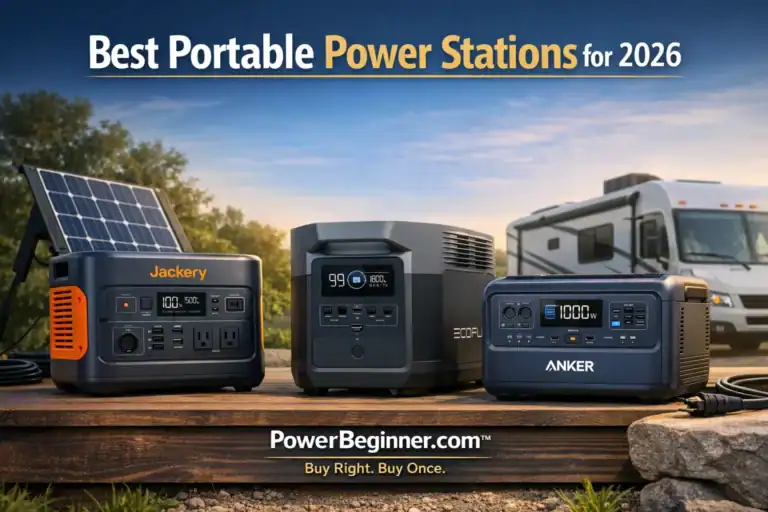
The power station market has matured significantly. Several brands consistently deliver quality products.
Established leaders:
- Jackery: Pioneer of the category, refined products, excellent support
- EcoFlow: Fast charging technology, competitive pricing, innovative features
- Anker: Electronics expertise, strong build quality, good support
- Bluetti: Good value, expanding lineup, solid performance
- Goal Zero: Premium pricing, rugged designs, outdoor focus
What to look for:
- LiFePO4 battery chemistry (3,000+ cycle life)
- Capacity matching your needs (dont overbuy)
- Output exceeding your highest-draw device
- Reputable brand with US support and warranty
- Reviews confirming real-world performance
What to avoid:
- Unknown brands with no track record
- Suspiciously low prices on high-capacity units
- Lithium-ion batteries in new purchases (unless heavily discounted)
- Products without proper safety certifications
Frequently Asked Questions
How long do power stations last? LiFePO4 models last 3,000+ charge cycles before reaching 80% original capacity—roughly 8-10 years of regular use. Older lithium-ion models last 500-800 cycles (2-4 years). Calendar life also matters; batteries degrade slowly even when unused.
Can power stations run air conditioners? Small window AC units (5,000-8,000 BTU) can run on large power stations (2,000+ Wh with 2,000W+ output) for limited periods—typically 2-4 hours. Central AC requires more power than any portable power station provides. For extended AC needs, generators are more practical.
Are power stations safe to charge overnight? Yes. Quality power stations have battery management systems that prevent overcharging. Once full, charging stops automatically. This is no different from charging your phone overnight—modern lithium battery technology handles it safely.
Can I use a power station while charging it? Yes, this is called pass-through charging. Most quality stations support it. Some limit output during simultaneous charging. Check your specific model’s specifications.
How often should I charge my power station? Charge before any planned use and after any significant discharge. For emergency preparedness, check charge monthly and top off as needed. Avoid letting batteries sit depleted for extended periods.
Do power stations work in cold weather? Performance decreases in cold conditions. Most stations function down to 32°F (0°C) but with reduced capacity and slower charging. Some models have heating systems for cold-weather use. Bring stations indoors when possible during cold weather.
Can I expand my power station’s capacity? Some brands (notably EcoFlow and Bluetti) offer expansion batteries that add capacity to compatible base units. Most stations are not expandable—what you buy is what you get. If future expansion matters, choose an expandable system.
Last updated: February 2026. This guide is for educational purposes. Always follow manufacturer instructions.